
What is Dragon Quest 7: Reimagined?
Dragon Quest 7: Reimagined is a faithful modern-day remake of the game that was originally released in the year 2000, then remade for the 3DS in 2013 for Japan, and then in 2016 for North America. It is, of course, a turn-based JRPG with a roughly 45-hour run time.
As someone who only started his Dragon Questing with the 11th installment, then moving onto the Nintendo Switch ports of the first 3 games, I was very surprised and delighted with the announcement of this game last year. Its cute aesthetic blended with the iconic art style from the late Akira Toriyama for its characters felt like a warm invitation for a long and whimsical journey, and oh boy was it so.
Dragon Quest 7: Reimagined excels in many ways as a modern-day remake. Not only does the game have more modern era graphics that mesh well with the art style for characters and monsters, but it also has a very smooth combat system with amazing animation and effects. But beyond all this is a fantastical story with many layers of intrigue that gripped me from start to finish.
Developer & Publisher // Square Enix
Platforms // PC, PlayStation 4|5, Nintendo Switch 1|2, Xbox
MSRP & Release Date // $59.99, February 5th, 2026
Reviewed On // Xbox
Piecing Together the Past
- A plot centered around finding mysterious tablet fragments to go to long-forgotten islands.
- Each island has its own story to tell.
Dragon Quest 7: Reimagined starts with the main character waking up on the day of the festival in his hometown, Pilchard Bay, where he is joined by his childhood friend Maribel to go to the castle of Estard to meet his best friend Kiefer, the prince of the kingdom. Shortly after, they stumble upon a mysterious shrine that tasks them with finding stone tablets to open its doors. After finding the tablet fragments, the main character, Kiefer, and Maribel find themselves transported to an island lost to time.
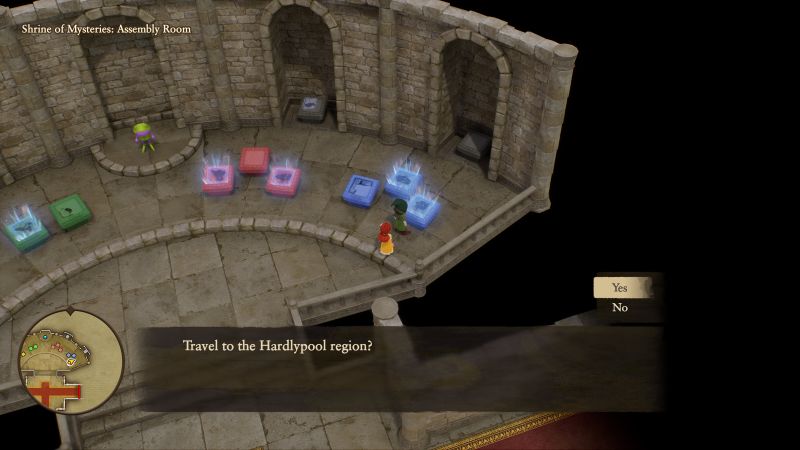
But all is not as it seems, as the island is shrouded in mysterious darkness and monsters. Leading the gang to venture off in search of the source of the darkness and return to the shrine to find that the island they went to was discovered near Pilchard Bay in the present. This one adventure would then turn into many, as new tablet fragments are found that force the band to go to many new islands and discover various stories as to why these islands disappeared and how the passage of time affected them.
Obviously, there are many mini tales on each discovered island. The first island is about a monster that made townsfolk disappear, with other islands like one with a volcano obviously should have ended in an eruption without the intervention. My favorite of the islands actually comes from one of the “Gray” islands that tells a more sorrowful tale. It is centered around the characters of Lavender and Carraway. This was a tale of love that was never meant to be, and the story involves going to the past and present multiple times to see the events change. Seeing how the tale ended left me feeling sad, not unlike the rest of the main story of the game.
The Story of Light and Dark Dragon Quest 7: Reimagined
- A tale of becoming the hero in a sinister plot.
- Memorable characters that make the journey all the more worth it.
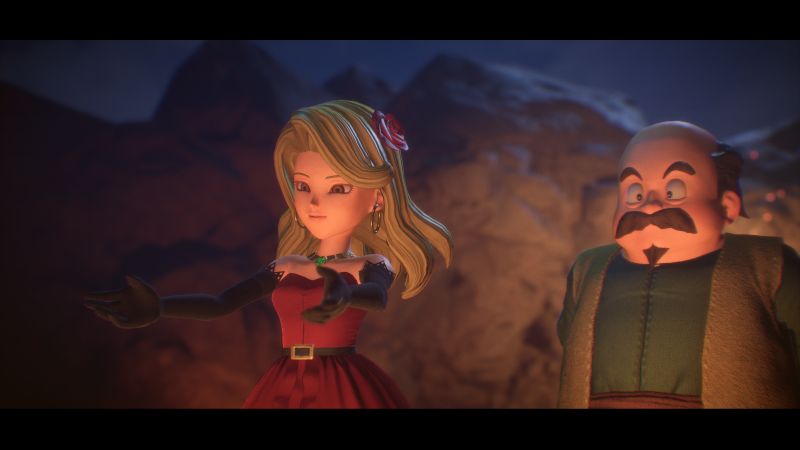
The moment-to-moment adventure of Dragon Quest 7: Reimagined is about finding the tablets and going back and forth to the islands. The rest of the game tells the story of many intriguing settings and the darkness that befell them. Along the journey, new members of the party are found. Like the beautiful female dancer Aishe, who hails from a group of nomads called the Roamers, who are on an important religious quest. Meanwhile, a child who rides a wolf named Ruff is found in a more silly setting, a town where the dynamic of humans and animals is reversed.
When it comes to the characters, everyone has a very impressive English dub. Maribel sounds bratty, while Kiefer’s voice acting captures the posh and adventurous spirit of a prince. Normal NPCs in most cutscenes are no slouch either, with one character putting on an impressive German accent. There were no weak performances, which is great!
In the background, however, is a more sinister tale where the mystery unfolds slowly as the islands return to the present bit by bit. The first act is pretty lengthy as you go through each mini tale of every island. The second act is a bit shorter as the main plot surrounding the darkness and how its source, the main antagonist, fragmented the world that the party pieces back together. It’s a tale that many Dragon Quest fans should come to expect, and it makes you feel like a hero throughout, with plenty of stops along the way in fantastical places and plenty of treasure to sniff out.
A Vibrant, Diverse World Filled with Treasure
- A world with distinct locations and NPCs that have unique writing.
- Every location and dungeon is filled with treasure and collectibles.
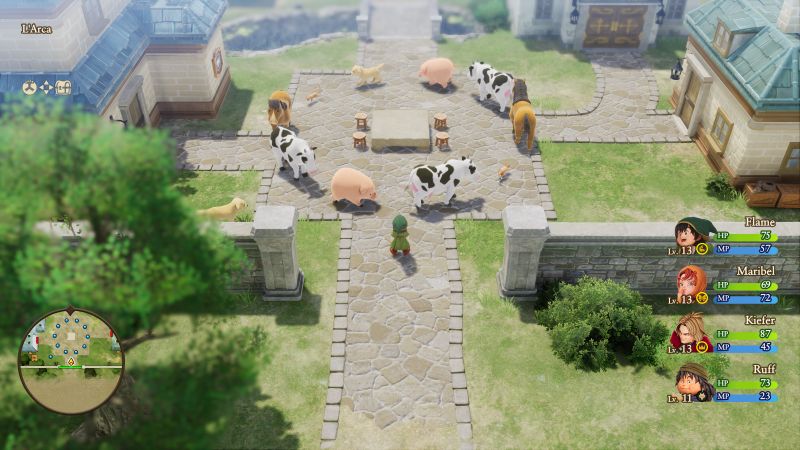
The world in Dragon Quest 7: Reimagined is one filled with childlike wonder and worldwide inclusion. Lush greenery, eerie caves, long stretches of desert, and the vast expanses of the sea all in between create a lovely world to explore with different, unique locations. As mentioned before, one city can be between a castle and the coast. While some are built near volcanoes, others are just in ruins. Every island offers so many unique locations to wander about.
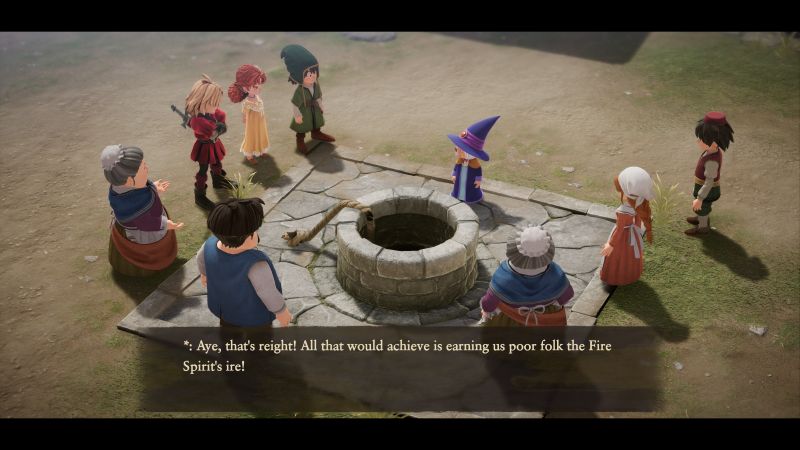
What stood out in every location was the approach to writing for all of the characters. Some would speak broken English or safe-for-work slang and also throw in some flavors of French and German, depending on the location. It made exploring the world feel just like that. Exploring a world similar to ours, with different cultures and even festivals. For example, the town near the volcano has an annual ritual where they throw hats set ablaze in the volcano itself to appease the spirit they believe in.
Not only that, but each house and every nook and cranny is filled with treasures to find. Dressers, nightstands, breakable pots, barrels, and even wells that you can dive into will always have valuable treasure. Whether it is medicine, equipment, or mini medals. Mini medals are collectibles that you can turn in for really good items. Such as an equipable monster heart that can summon rare metal slimes that give a lot of XP to level up, or a reusable stone that heals your whole party in combat. Speaking of which…
The Smooth Combat of Dragon Quest 7: Reimagined
- Smooth transitions to combat with incredible attack and enemy animations.
- Bosses present unique challenges in every encounter.
- The “Let Loose” system is a fun way of exploiting the class system.
The combat in Dragon Quest 7: Reimagined is wonderful. It is, of course, the series signature turn-based combat. What helps make it stand out from the get-go is the absolute smoothness of the attack and enemy idle animations. The wiggly slimes and expressiveness of some of the dancing demons stand out in my memory immediately. The fire and ice effects in spells are really cool and have a visual impact to them, as well as some of the melee strikes where Kiefers sword could turn into a glowing red axe to lower the defense of a foe. Not only that, but there is very little downtime after an encounter, as the loading times back to the world are very quick. You can also see where enemies are to run over and engage them directly, as opposed to random encounters.
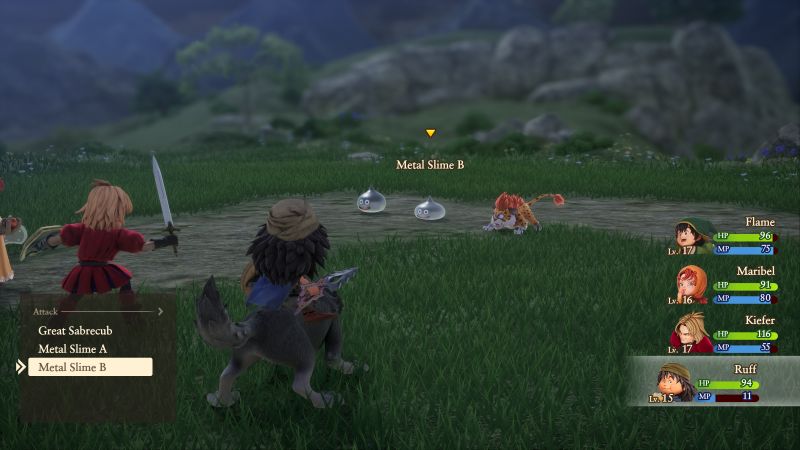
The combat itself is the usual mix of attack, defense, and a mix of spells and abilities to keep your party in tip-top shape and take down sometimes cute and sometimes terrifying foes. Bosses have some of the usual fixings and mechanics. Some of the bosses have a weird mix of difficulty, though. The first few involve a giant crab that posed more of a threat than the giant hammer-wielding open boss outside of the dungeon. Whether it was a spinning robot with a giant mouth and face in its stomach with 2 swords, or a big ol’ cyclops that can stun the party and deal a devastating blow with its club, the usual strategies like buffing defenses and attack power with just the right attack abilities pull through, especially when you get to “let loose”.
Letting loose triggers a special power from a character’s chosen class before acting on their chosen turn when it is activated. For example, the main character’s starter power can nullify a single attack from an enemy, which is very useful in boss encounters. Meanwhile, Kiefer gains more attack strength while losing defense, turning him into a glass cannon, and Maribel’s power can make her spells critically hit. This helps create builds from the start of the game that shape what these characters can become, thanks to the “Vocation” class system in the game.
A Deep Class System
- Incredible variety of skills and build variety.
- The dual class system allows for devastating combos.
Partway through Dragon Quest 7: Reimagined, you unlock the ability to choose other classes than the ones you start with for each character. You will have more varied Warrior, Priest, and Mage attacks to learn, but it gets much more interesting after you unlock more “advanced” classes. Such as the Gladiator that can turn any character with the right equipment into a devastating melee user, or a Sage that brings more devastating wind and revive magic to the table. There are more fun classes in this system, however. Beast Master can summon slimes, dragons, and other beasts. At the same time, the Sailor can drop cannonballs and aquatic-themed attacks.
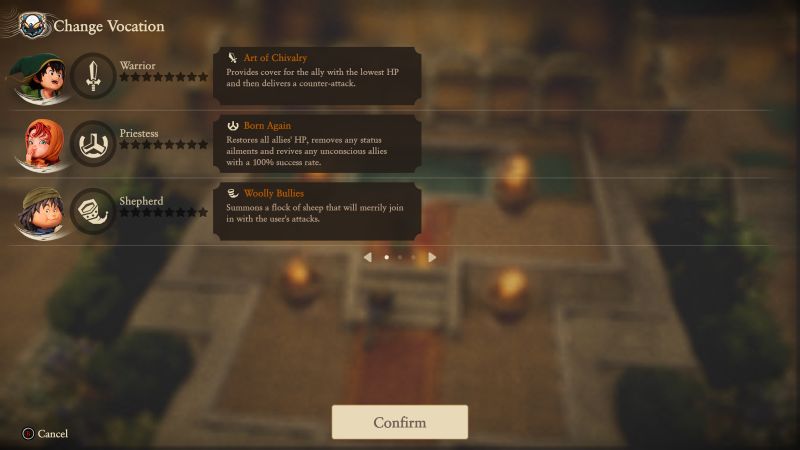
The trade-off in this system is the fact that any unlocked skills only apply to that selected Vocation. This, of course, sounds bad, but you can choose two Vocations at a time. Allowing for a mix of might and magic, or a summoner healer. The possibilities made grinding in the game very much worth it. But the grind would not be anywhere near enjoyable without some really useful accessibility settings.
Generous Accessibility Settings
- Colorblind settings.
- Modification of XP, gold, and combat challenge.
- Useful auto-battler and instant kill mechanics to reduce time spent grinding.
Dragon Quest 7: Reimagined has a very normal approach to accessibility. From the outset, there are only color blind options as far as accessibility settings go. But the movement and combat system can be enjoyed at your own pace. You also have difficulty settings to change how dangerous foes can be, how much XP you get, and how much gold you earn. I played the game fully on the “normal” settings and enjoyed myself throughout. You can also use a very smart “auto-battler” that lets the game play itself for you in combat.
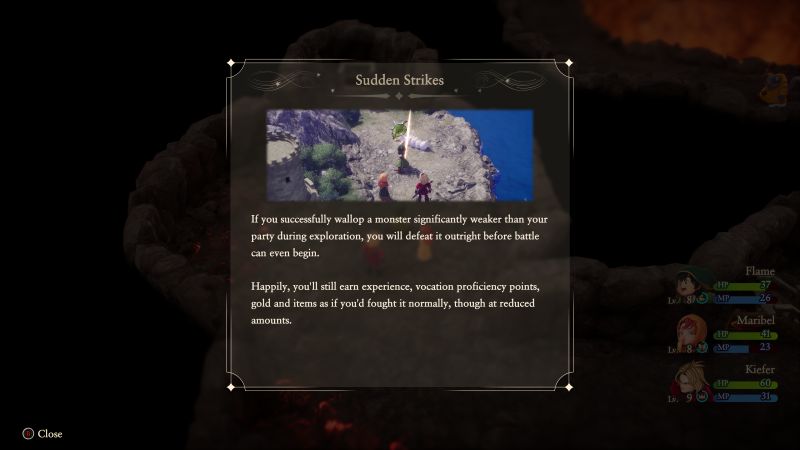
It covers spells, attacks, healing, revives, and the like. I used this a lot to reduce a lot of time grinding partway through the game. But I never used it in boss encounters to ensure I was not cheating myself out of a deserved victory. In addition to this, you can also instantly kill low-level foes when you attack them in the world. This allows you to get just enough XP, gold, and Vocation points to make the skip worth it.
Slick UI, Near Flawless Performance, and Beautiful Music
- Easy to navigate UI that is lovingly crafted.
- Almost perfect technical performance in the game.
- A great orchestral soundtrack that is right at home in Dragon Quest.
Finally, Dragon Quest 7: Reimagined has a very easy-to-navigate user interface. From the settings to the equipment and items, I was never overwhelmed or lost. I also found the dialogue text easy to read and always knew where to go with quest waypoints. The only problem on the side of things is the main map menu cursor. It moves very slow and there is no setting to move it faster.
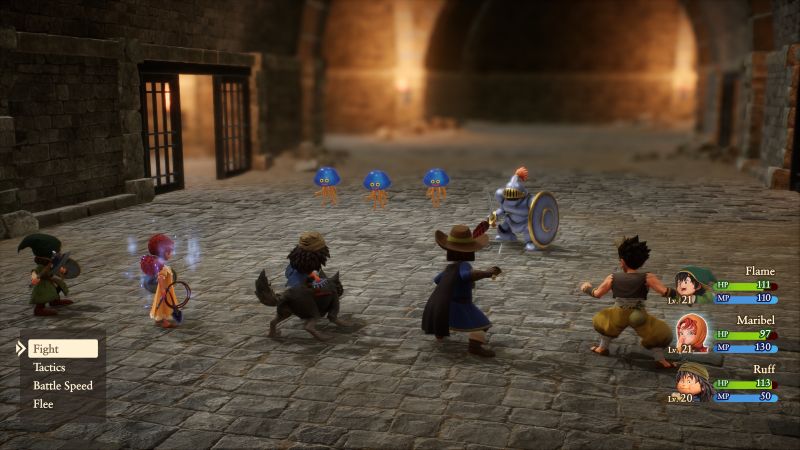
My experience in the game was flawless. No real bugs or crashes to report on. Everything was seamless, but there was one visual problem that stuck out to me. Considering the game has a diorama approach to its environments, it uses a limited draw distance from the main character. In one of the very final islands I unlocked, one surrounded by mist. I found some lines present in the city when moving vertically around town that were being caused by the draw distance that I could not modify on the Xbox version. Aside from this, there are no other problems to report. No audio problems either.
The music in the game is a beautiful symphony of orchestral tracks. The music, when exploring the world, adds to the feeling of wonder. Meanwhile, of course, battle music captures the tone of being challenged. My favorite was the fun and eccentric song that plays when you use the magic carpet. It adds to the “kid-like” wonder that is ever-present in the game.
Final Remarks on Dragon Quest 7: Reimagined
The best way to describe my final thoughts on Dragon Quest 7: Reimagined can be easily summarized by how the save system works. In every Dragon Quest game, you manually save at churches. When completing the save, you can either choose to continue or close out to the main menu. When exiting, the priest will wish the players a peaceful respite, and upon returning to the game, they will hope you are in good spirits when continuing your journey. The point being, that Dragon Quest 7: Reimagined welcomes you with open arms, letting you journey forth into its warm and vibrant world and return feeling proud like the hero of its story. It is a tale you should not sleep on.
Final Score: 9.5/10
Disclaimer – Square Enix provided a key for review purposes.
Pros:
- Distinct Art Style.
- Wonderfully Crafted World.
- Memorable Story.
- Smooth Gameplay.
- Great Accessibility Features.
- Fantastic Orchestral Music.
Cons:
- Map Cursor is way too slow.
- Some draw distance problems.
The copyright of the images used in this article is jointly owned by SQUARE ENIX CO., LTD. and other co-owners. The unauthorized reproduction and distribution of the images is prohibited.

3 comments
[…] is standard procedure for JRPGs in general, and Dragon Quest 7: Reimagined is no exception. Considering how often you will be grinding, make sure to spend some of the gold […]
[…] in religious terms. But this will be how you open the Blue Door in the Grand Conjuratorium in Dragon Quest 7: Reimagined. The chamber within has some good treasures, including a tablet […]
[…] you will get all 4 jewels to progress through the rest of the story. I hope this guide helps you in Dragon Quest 7: Reimagined, dear […]
Comments are closed.