
What is Grind Survivors?
This generation saw the survivors-like sub-genre of roguelikes explode in popularity. Each subsequent game tries to introduce its unique take on the “just one more run” hook that has popularized the sub-genre.
Pushka Studios’ Grind Survivors is an entry into the “survivors” genre that successfully marries fast-paced bullet-hell combat with deep, persistent meta-progression. Despite the constant progression, the game suffers from a lack of initial clarity and some high-stakes random mechanics.
Developer & Publisher // Pushka Studios, Assemble Entertainment
Platforms // PC, PlayStation 5, Google Play, Xbox Series X|S
MSRP & Release Date // $12.99 (Steam) $14.99 (Consoles), March 16th, 2026
Reviewed On // Xbox Series X
Gameplay and Core Mechanics
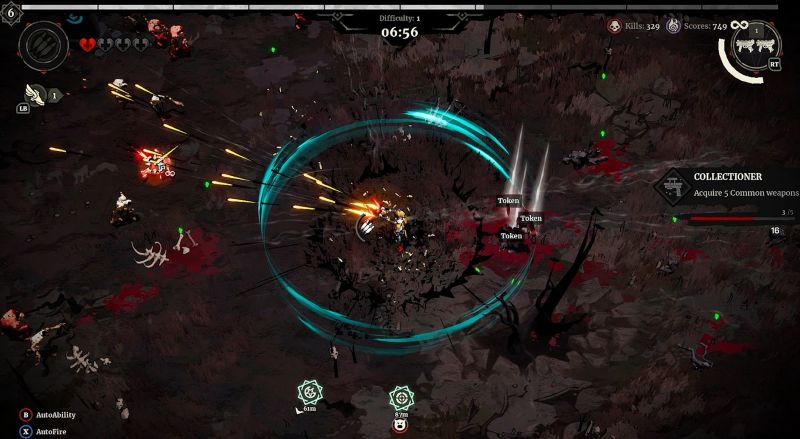
- Toggle between precise manual aiming or a relaxed auto-fire mode to mow down hordes.
- Classic Bullet-Hell combat galore while maintaining your shield and HP against massive enemy waves.
Grind Survivors offers both Auto fire and manual modes, accommodating different playstyles. The Auto fire mode is the tried-and-true bullet hell mode, where your character automatically shoots. So you are free to move and dash around, which can be controlled on your left hand (where dash is LB/L1). Conversely, the manual mode turns Grind Survivors into a twin stick shooter.
Combat features a distinctive, large circular fire effect when shooting, which, while visually engaging, can sometimes be distracting and obscure the character during intense action. Players manage their HP and shield while mowing down hordes of enemies across three distinct biomes: burned forest, bastion, and scorched grounds.
Trivial Pursuit
- Balance DPS and speed by prioritizing SMGs over less effective gear.
- Combine META power-ups with auto-fire for relaxing, one-handed endgame runs.
No doubt using the manual-fire controls is more precise in targeting the threat you want to deal with. However, once I selected all the runs I wanted during a run, I would often find myself settling back into auto-fire mode, to play with one hand and relax. This does trivialize later runs, but only if I got lucky with the power-ups I selected by mid-run.
In addition to the META power-ups, I also defaulted to SMGs as they provided the Goldilocks balance between DPS, speed, and reload rate. Other weapons like the revolver, shotguns, and rail gun weren’t as effective. Once again, trivializing the gear aspect of the game.
Grind Survivors Progression and Systems
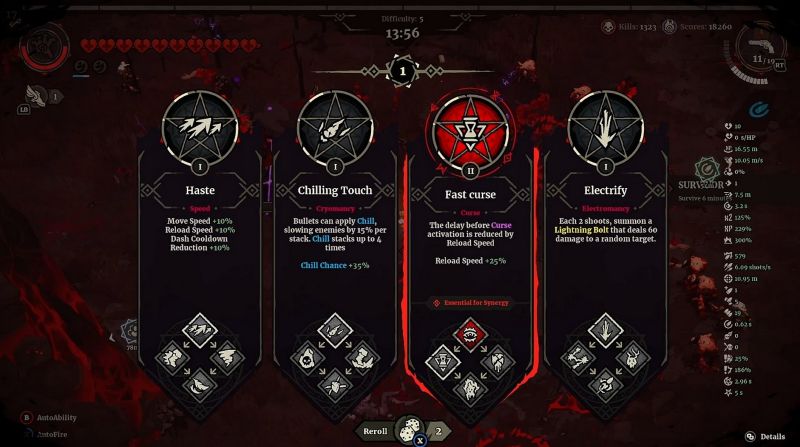
- Unlock long-term depth through complex meta skill trees and the Forge.
- Collect Hell Dust from mini-bosses to upgrade essential runes and unlock permanent buffs.
A significant portion of the depth of Grind Survivors lies in its progression systems, which are slowly unlocked, including the forge and meta skill trees. This drip-feed of features, while providing longevity, initially leaves the player in the dark. For instance, the function of “ash” is not clearly explained until after the initial discovery. To add, the ever-important Hell Dust, which is used for your skill trees and runes, can be attained by defeating mini-bosses and bosses during runs.
Forged in Hell… Dust
- Infuse, recycle, and upgrade weapon rarities to maximize combat stats.
- Risk Ash resources on weapon improvements for high-stakes gear progression.
The Forge is where you can infuse, improve, recycle, or equip runes. Weapons come in four different rarities (green, blue, purple, and orange) and with different levels. Infusing weapons requires four of the same rarity and weapon levels to increase their rarity level.
As you complete runs, you will unlock higher difficulty levels that net you higher weapon levels. However, you cannot infuse lower-level weapons into higher-level weapons. In other words, you will be constantly enfusing or recycling weapons into ash in between runs. It was addictive at first, but eventually you will reach a point where you will have dozens, if not hundreds, of weapons, and it quickly becomes a chore.
Weapons also have special traits like providing additional rerolls, weapon range, and the like. So it’s best to always read stats very carefully when selecting which ones to invest in. Speaking of investing.
Improving weapons also has a distinct risk and reward element to it as well in Grind Survivors. When improving weapons, the Forge will present you with a failure percentage. If you fail, your weapon’s stats will reset to their normal level, and you lose your invested Ash.
Meta-progression is driven by three main skill trees: pride, greed, and wrath, offering persistent buffs. Runes can be selected during a run, adding extra bonuses like enemies receiving extra damage, which allows for tactical build diversification. The system also includes a bonus that doubles HP bonuses, aiding survivability.
If You Know, You Know
- Prioritize health, shields, and ricochet for the most efficient clearing builds.
- Complete Codex objectives to unlock new runes.
During my playthrough in Grind Survivors, I quickly learned that the most effective tactics available usually involved increasing health, shields, ricochet, and bullet splits. Any other power-ups were discretionary, and using any form of these combination of these power-ups helped me out clear areas in no time.
Another meta-progression system in Grind Survivors comes through the Codex. The Codex comprises different objectives for you to strive for. Once achieved, it provides progressions such as new runes for you to unlock.
For the Emperor, err, I mean for Grinding?
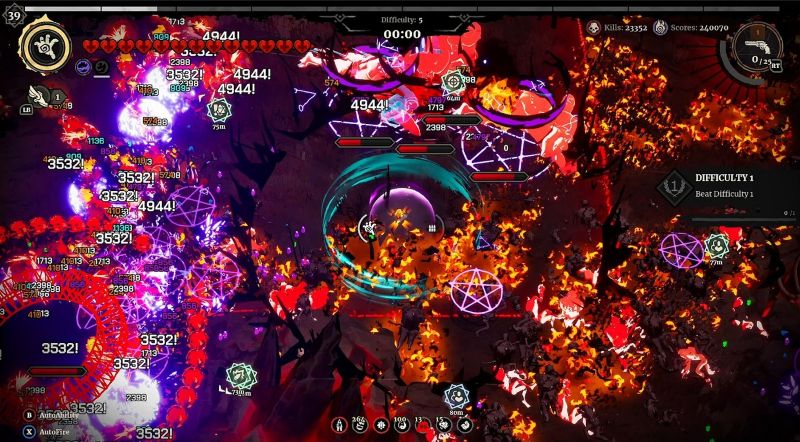
- Master four unique heroes with distinct screen-clearing abilities like Vanta’s push.
- Sudden red-barrier arenas that force intense, close-quarters combat that overstay their welcome.
There are four unique characters to master: Cascade (bullet storm), Solar (rail gun), Vanta (all mighty push), and Riven (berserk), each offering a drastically different approach to clearing the screen. Each character consists of a blackened silhouette face with different colored lights for eyes.
My favorite character was Vanta. Their mighty push ability emits a powerful 360-degree shockwave that knocks back all nearby enemies and deals minor physical damage. Perfect for getting a breather when getting boxed in. Speaking of getting boxed in…
Periodically, the map throws some enclosing area through a red barrier; they would often linger longer than expected, and you’d find yourself circling even though you cleared the small, barred-off location. This is a common mechanic in bullet hell games, but usually, they are cleverly introduced, like seeing a barrier form and slowly enclose you in other survivor-like games like Vampire Survivors. But in Grind Survivors, a red line just randomly appears. However, barriers’ long duration does make them a nuisance, but nothing a good build can’t handle.
Graphics, Audio, and Performance
- Clean, yet dull, post-apocalyptic visuals inspired by classic sci-fi marine tropes.
- Weird gunfire lighting effects.
- Smooth, lag-free performance on Xbox Series X during heavy action.
- Uninspired sound effects and soundtrack.
Grind Survivors has some clean, yet simple graphics and art style. The environments take on the post-apocalyptic hell on earth motif, while the characters look like distant cousins of Warhammer 40K Space Marine.
Some strange lighting was noticeable when firing weapons, which, in reality, is all the time during the game. The gunfire light would regularly clip your character, instead of reacting to your character, which really looked weird. But when you’re dealing with dozens of demons at any given time, you’ll quickly forget about it during unleashing hell on, well, demons from hell.
The audio design isn’t something to write home about. For the most part, weapon sound effects sound decent, but lack oomph in their delivery. While the soundtrack sounds like it was ripped straight from DOOM, though less inspiring. The heavy metal tracks do attempt to stand out, but it’s nothing to write home about.
The environments, too, weren’t too compelling either. The hellish wasteland doesn’t really go beyond the horror/post-apocalyptic themes Grind Survivors is clearly going for.
When it comes to performance on the Xbox Series X, the game performed admirably. Especially with hundreds of enemies on the screen, Grind Survivors didn’t miss a beat. It would have been nice if the game were an Xbox Play Anywhere title, but that is neither here nor there.
Lack of Accessibility In Grind Survivors
- Limited accessibility options, colorblind mode, and adjustable text to navigate.
Accessibility options are minimal, limited to color-blind mode and adjusting text sizes. More comprehensive settings would be welcome for a game with such intense visual effects. Though the game can be entirely played with one hand, that is worth noting as well.
Final Thoughts on Grind Survivors
- Compelling “just one more run” loop built on satisfying loot cycles.
- Progress through a steady flow of unlocks despite a steep initial learning curve.
Grind Survivors isn’t reinventing the wheel, but it does try its own spin on the ever-popular survivor-like titles. It offers a compelling loop of loot, infusing and improving weapons cycles that are built around robust meta-progression and varied character abilities. While the initial onboarding could be clearer, the Forge system is unduly stressful at first. But the constant flow of unlocks and escalating difficulty provides the necessary “just one more run” hook characteristic of the genre.
Final Score: 7.8 / 10
Pros
- Multiple Meta-Progession Systems
- Meaningful Loot and Forge System
- Stable Performance
- Multiple Control Options
- Addictive Gameplay Loop
- Tons of Build Options
Cons
- Onboarding Could Be Clearer
- Bland Character and Environment Designs
- Weird Lighting
- Limited Accessibility Options
- Constant Weapon Infusing Can Be a Chore
- Uninspiring Audio Design
