
What is the Rayman 30th Anniversary Collection?
While iconic platforming mascots like Mario and Sonic dominated the 90’s, Ubisoft threw its hat into the ring with Rayman. Sporting stunning visuals, an enchanting score, and a high level of challenge, this 2D platformer took the world by storm when it released on the original PlayStation.
The series continued with a few great escapes and crafted some legendary tales. With Rayman celebrating its big 30th birthday, Digital Eclipse teamed up with Ubisoft and Atari to create Rayman 30th Anniversary, a lovingly crafted collection of key versions of the original 1995 classic.
After spending a lot of time with this blast from the past, I’m happy that Rayman is celebrating his 30th anniversary well, despite some musical missteps.
Publisher/Developer: Ubisoft/Atari, Digital Eclipse
Platforms: Nintendo Switch, PlayStation 5, Xbox Series X/S, PC
Release Date: February 13th, 2026
Price: $19.99 Digital, $29.99 Physical
Platform Reviewed On: Nintendo Switch 2 via NS1 BC
What is Rayman (1995)?
- Released in 1995, Rayman is a 2D platformer featuring colorful worlds, expressive animation, and challenging gameplay.
- Rayman’s moveset expands over the course of the game, including punching and hovering in the air with his helicopter hair.
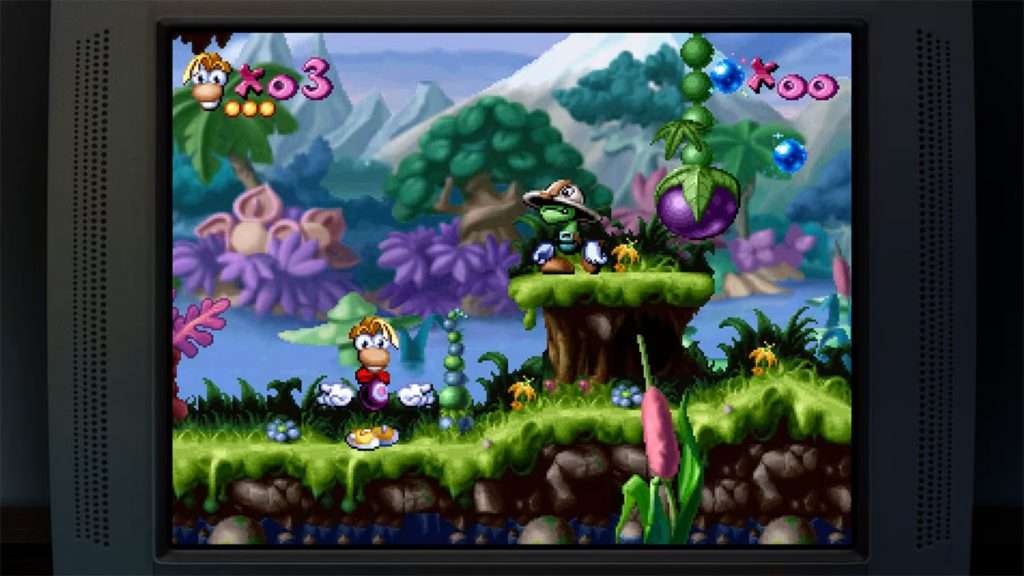
Rayman (1995) is a 2D platformer where the limbless wonder explores colorful worlds in the Valley, a place within the Glade of Dreams. He’s tasked with freeing the Electoons trapped in cages and defeating Mr. Dark. This has him jumping, punching, and climbing through a variety of worlds.
From vibrant forests, lands composed of musical instruments, and even one made of candy, Rayman’s world is one ripped out of a cartoon. The levels are built with replayability in mind, as the limbless hero doesn’t have all his abilities from the start.
By saving enough Electoons, you unlock moves like Punching and Hovering in the air. And you will need to revisit levels, as they are quite challenging. Enemy placement, tricky hazard placement, and more demand that players pay keen attention to Rayman’s surroundings.
What makes Rayman (1995) so special is how it genuinely feels like an animated cartoon brought to life. Even with the game’s high challenge, seeing Rayman and his world come alive is a sight to behold.
So overall, the original Rayman has its issues, but it’s a solid 2D platformer that inspired platforming perfection that we eventually got with Rayman Origins and Legends.
Building the Limbless Wonder – Games Included
Included in the collection is the original Rayman, released in 1995 for the PlayStation 1 launch. Alongside the original PlayStation release are other versions of the game, including the following:
- Atari Jaguar
- MS-DOS
- Game Boy Color
- Game Boy Advance
Other versions of Rayman 1 exist outside of what’s included here. Being able to play the SEGA Saturn and Nintendo DSi Ware would’ve been fun inclusions, but the pillar platforms being represented in this collection are more than enough.
Different Colored Lums – Version Differences
- Multiple versions are included in this collection, with each version offering something unique. The PlayStation version, for example, features the best presentation and wide-screen support.
- The Game Boy Color version stands out as a stand-alone experience.
- The MS-DOS version is included, featuring over 120 additional levels.
The version differences between the five versions of Rayman are interesting. The PlayStation original features proper wide-screen support for standard stages, and in my opinion, the best presentation. Meanwhile, the Game Boy Advance version stands out as the worst due to screen crunch and a lower-quality soundtrack.
By far the most interesting versions of Rayman in this collection are the MS-DOS and Game Boy Color ones. MS-DOS Rayman matches the visual quality of the PS1 original and also includes 120 additional stages (with each stage pack acting as a separate game with its own save slots). These levels add a ton of content to the experience, and as someone who never experienced these stages before, they make it feel like a new game. However, the audio issues present in the original MS-DOS release remain intact. It’s not overly distracting, but it’s a shame they weren’t addressed in this release.
The Game Boy Color release functions as a stand-alone experience, due to the hardware at the time. Levels are unique to this version and are genuinely fun to play through. Lastly, there is the Atari Jaguar version, which plays similarly to the PS1 version. However, the difficulty is streamlined, and other minor differences are present, such as item placement.
Overall, having access to five unique versions of a single game is awesome, and the fact that each version offers something ‘different’ cements this collection as the best window into Rayman’s first adventure.
Seasoned Rays, Man – Quality of Life Additions
- Quality of Life and Accessibility features on offer include rewinding (except the MS-DOS version), enhancements to enable, and customizable controls for every game.
Known as one of the most challenging 2D platformers on the original PlayStation, the team at Digital Eclipse included several quality-of-life additions to streamline the experience.
For the original PlayStation and MS-DOS versions, you can enable various features before booting the games. These include Max Lives, Max Health, and even unlocking all of Rayman’s abilities. These are immensely helpful, as several levels in these versions demand a lot from the player.
And every version (except the MS-DOS games) supports the rewind feature, helping correct tricky jumps or avoid accidentally bumping into an enemy. In addition, every version supports multiple save files, too.
Outside of these QoL additions, you can change the controls for each game. My recommendation is to map ‘Action’ to one of the Trigger buttons, as that activates Rayman’s run ability.
Exploring the Past – History of Rayman Content
- With over an hour of behind-the-scenes videos, concept art, and a playable prototype, Rayman 30th Anniversary honors the development history of the 1995 classic.
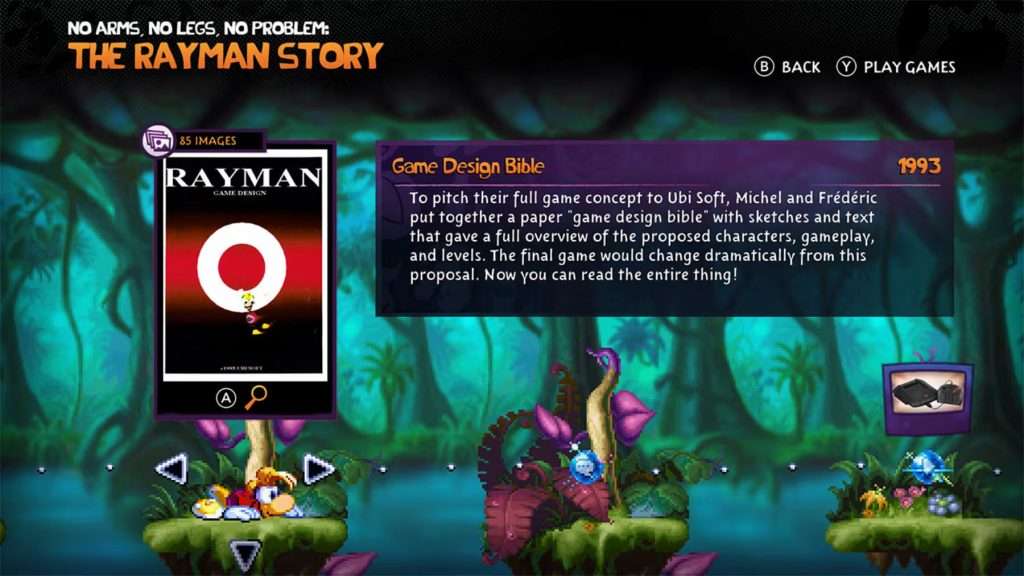
By far one of the coolest inclusions in this package is the behind-the-scenes features. For those who are unfamiliar with Rayman 1’s history, the game had two prototypes for the Super Nintendo. While the second one, further along, was lost to time, the original prototype that leaked online in 2017 is included in this release.
It’s a short experience, but it does showcase the concept of Rayman being an anti-virus program. And you can learn more about that through a game bible, released for the public for the very first time in this package. Video Game Bibles are enlightening, and having access to one of this quality is fantastic.
Completing this tour through history is an interactive ‘museum’ section. You control Rayman, jumping from platform to platform. Each platform has either a video clip of actual Ubisoft developers discussing the making of Rayman, concept art, and more.
While the emulation quality and Quality of Life features are strong, the History aspect of Rayman 30th Anniversary is nothing short of master class, and I earnestly hope Digital Eclipse gets another shot at a Rayman release. Would love to see something like this for Rayman 2 or Rayman 3.
New Jams – Music
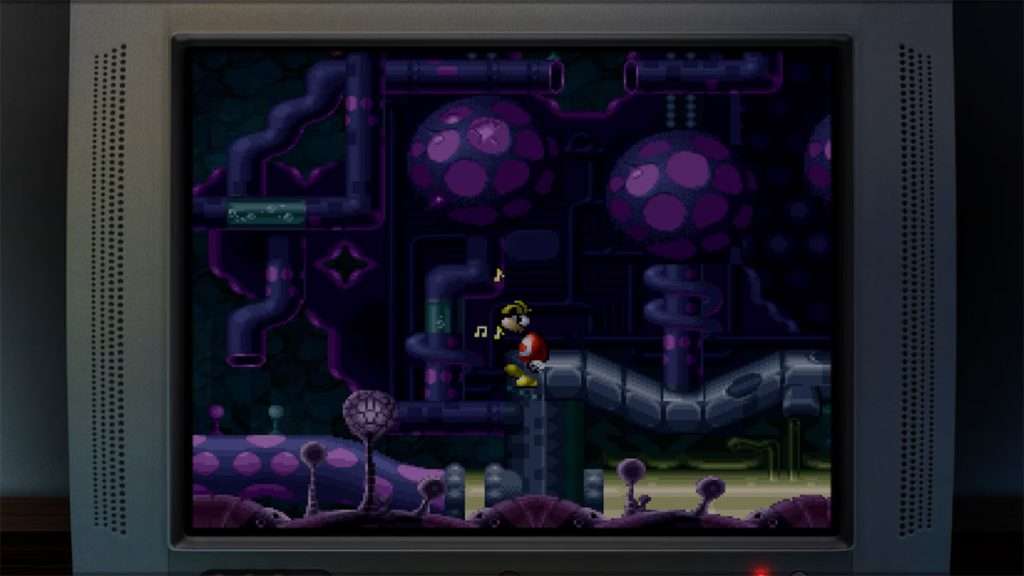
This aspect of the Rayman 30th Anniversary release is a disappointment, specifically that the game’s original soundtrack is completely replaced. The new compositions were done by Rayman Origins/Legends composer Christophe Héral.
I personally enjoyed several reimagined tracks, with my personal favorites being ‘Flight of the Moskito’ and ‘Harmony’. Both capture the otherworldly, magical vibes present in the original score. However, some tracks, like ‘Space Mama’s Play’, are downgrades of the original game’s tracks.
So, despite the attempt to largely recapture the magic that the original game’s composer, the late Rémi Gazel, offered, it is a shame that the original soundtrack is not an option. That is very glaring, considering how faithful and authentic the rest of the experience is.
Thankfully, Ubisoft is aware that people want an option for the original soundtrack. Maybe in the future, this issue will be rectified.
Closing Thoughts on Rayman 30th Anniversary
As a fan of the later titles, it was a treat seeing where it all began with Rayman 30th Anniversary. This classic 2D platformer, while flawed, holds up remarkably well in 2026. Great quality of life additions and a fantastic treasure trove of behind-the-scenes content make this a strong release despite the exclusion of the original soundtrack.
Score: 8 out of 10
This game was purchased for the purpose of this review.
Pros:
- Great quality of life features
- Multiple versions of Rayman (1995) ran well
- The history section is extensive, with video content and concept art
- Inclusion of MS-DOS Level Packs adds a ton of value to the package
- The new soundtrack has some enjoyable tracks
Cons:
- The original soundtrack was completely replaced
- Issues present in the original releases remain in this collection
