
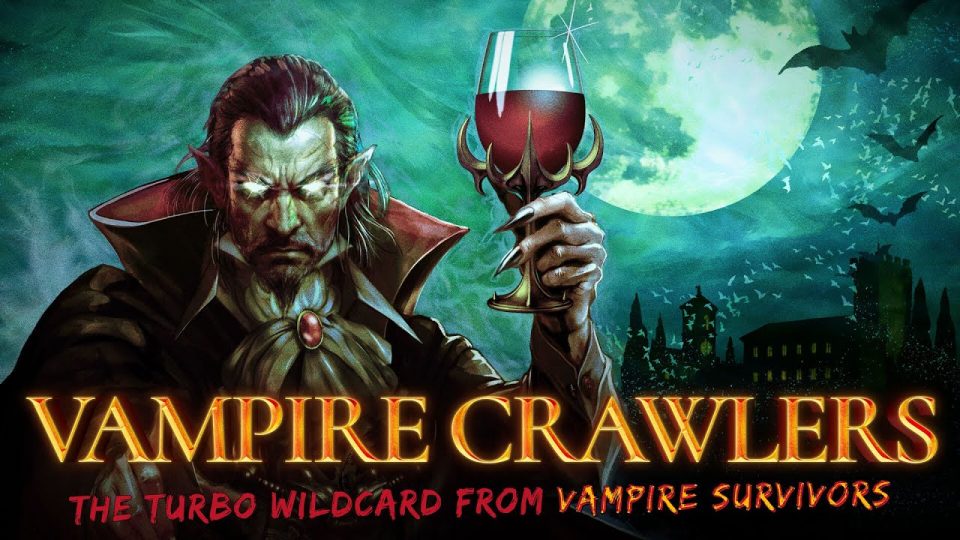
What is Vampire Crawlers?
In 2022, Vampire Survivors made its mark in gaming history. It’s a masterpiece that birthed an entirely new genre. Following that up is no easy task, especially when going in a completely different direction. Vampire Crawlers takes the Survivors DNA and transplants it into a deck builder roguelite dungeon crawler (say that 3 times fast), and somehow it still manages to capture everything that made the original great. poncle has concocted a new drug in video game form, and their knack for excellent game design needs to be studied.
Vampire Crawlers not only carries over the addictive progression loop that made Survivors impossible to put down, but wraps it around a deck-building system that is deceptively deep without ever becoming complicated. With the right build, you will feel like a god, and chasing that feeling is what makes Vampire Crawlers one of the best indie games of this year.
Developer: poncle, Nosebleed Interactive
Publisher: poncle
Platform: PlayStation 5, Xbox Series X|S, Nintendo Switch, PC (Steam)
MSRP: $9.99
Release Date: April 21, 2026
Presentation & Sound — A Light Show of Destruction
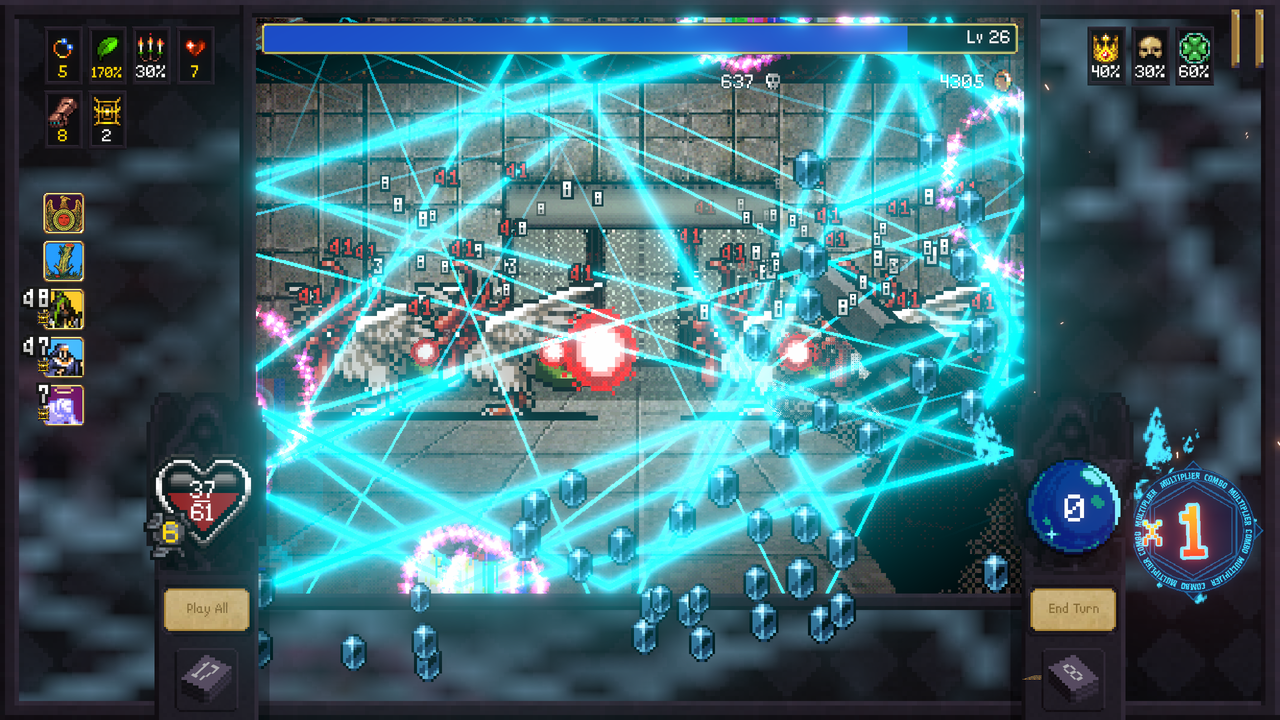
- Vampire Crawlers brings Vampire Survivors’ pixel art style into a first-person dungeon crawler perspective
- Weapon effects grow increasingly flashier as your card combos build
- New old-school voice acting adds personality absent from its predecessor
- Yoko Shimomura composed the main theme, elevating an already standout franchise soundtrack
Vampire Crawlers carries over Vampire Survivors’ pixel art into a first-person perspective, and it translates better than expected. The character sprites are what you’d expect, but the level designs look unexpectedly cool in the pixelated first-person style. However, the real visual highlight is the weapon effects. They don’t reach the epilepsy-inducing chaos of Vampire Survivors, but they still pack immense flair. As you chain more cards together, the effects grow flashier with every hit, and by the time you’re running a full hand, every cast lights up the screen in a burst of pixel art destruction that feels appropriately over-the-top for a poncle game.
The sound design is just as strong. Attacks land with a satisfying thump, the sound of picking up gems, and the level-up chime is pure dopamine, and the distorted, old-school style voice acting brings a bit of personality Vampire Survivors didn’t have. Then there’s the soundtrack, which was already a franchise highlight and somehow gets better here. With a main theme composed by the legendary Yoko Shimomura, Vampire Crawlers’ OST may very well have surpassed the original. The main theme is a must-hear of 2026.
Overview — Straight to Business
- Story is minimal—the gameplay loop more than fills the gap
- Choose from familiar Vampire Survivors characters, each with unique starting cards and a special ability card
- Select dungeons from an overview map with multiple levels of increasing difficulty
Don’t expect much narrative here—Vampire Crawlers is even lighter on story than Vampire Survivors, but the gameplay more than makes up for it. Each run starts at the Crawler select screen, where you pick a familiar face from Vampire Survivors, each with their own set of starting cards and a unique Crawler card that activates their special ability when played. From there, you pick a dungeon from the overview map. Most stages offer 2-3 levels with additional floors unlocking after clearing the previous ones, each stepping up in difficulty. Once you commit, you’re dropped into the first-person dungeon-crawling experience.
Dungeon Crawling — A Classic Feel with Some Twists
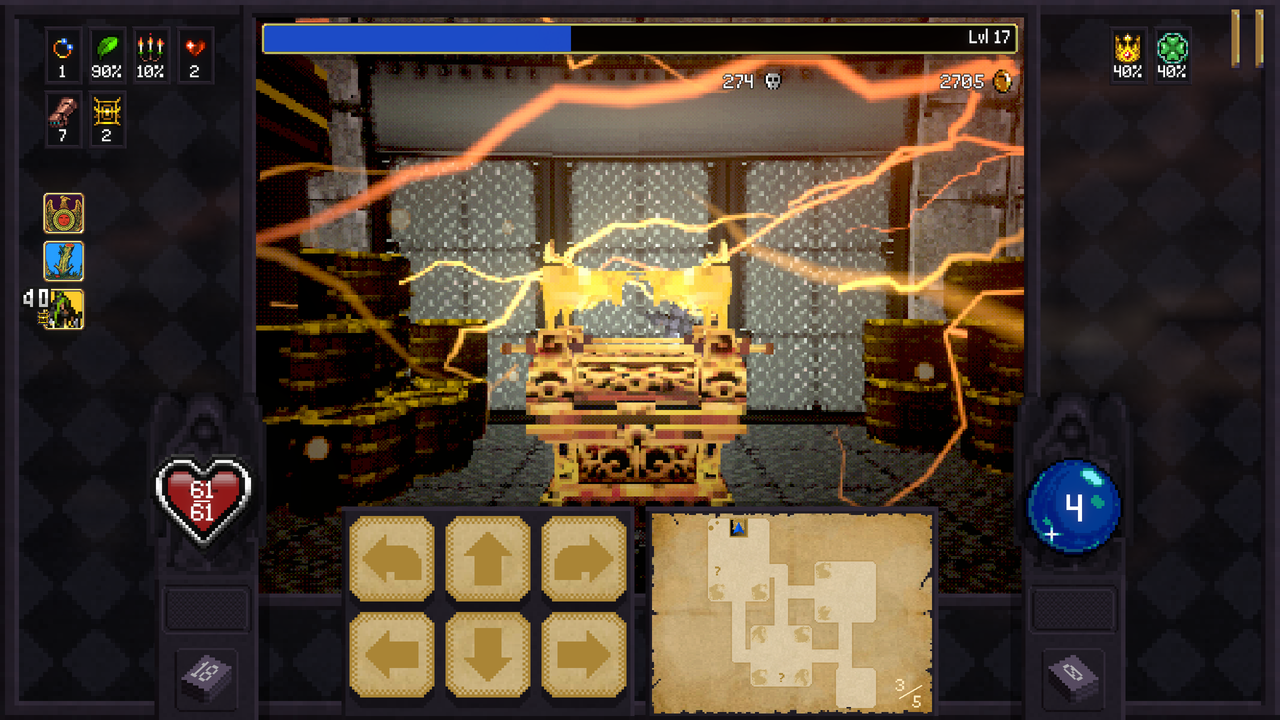
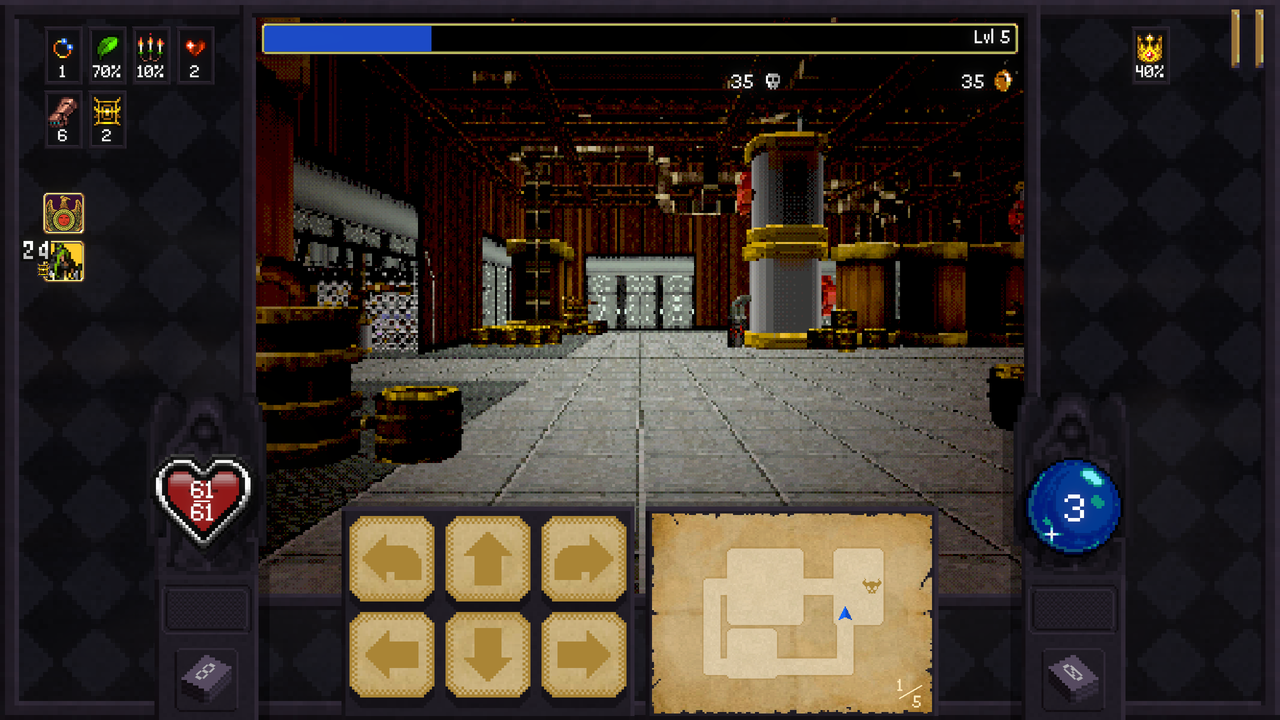
- The full dungeon map is revealed from the start, showing enemy placements and boss locations
- Treasure, breakable structures, and special events reward thorough exploration
- Defeating the floor boss digs you down to the next level
- Skipping fights is possible, but dangerous—leveling up is essential to survival
The deck-building card-based combat is definitely the main course of Vampire Survivors, but the dungeon crawling is key to the experience as well. Unlike most dungeon crawlers, your map is fully revealed from the start. All enemy placements and the boss location are visible before you take a step. You’ll work through each floor battling enemies for experience and hunting down treasure, breakable structures, and special items that can hold new cards, modifiers for existing ones, coins for between-run upgrades, and more.
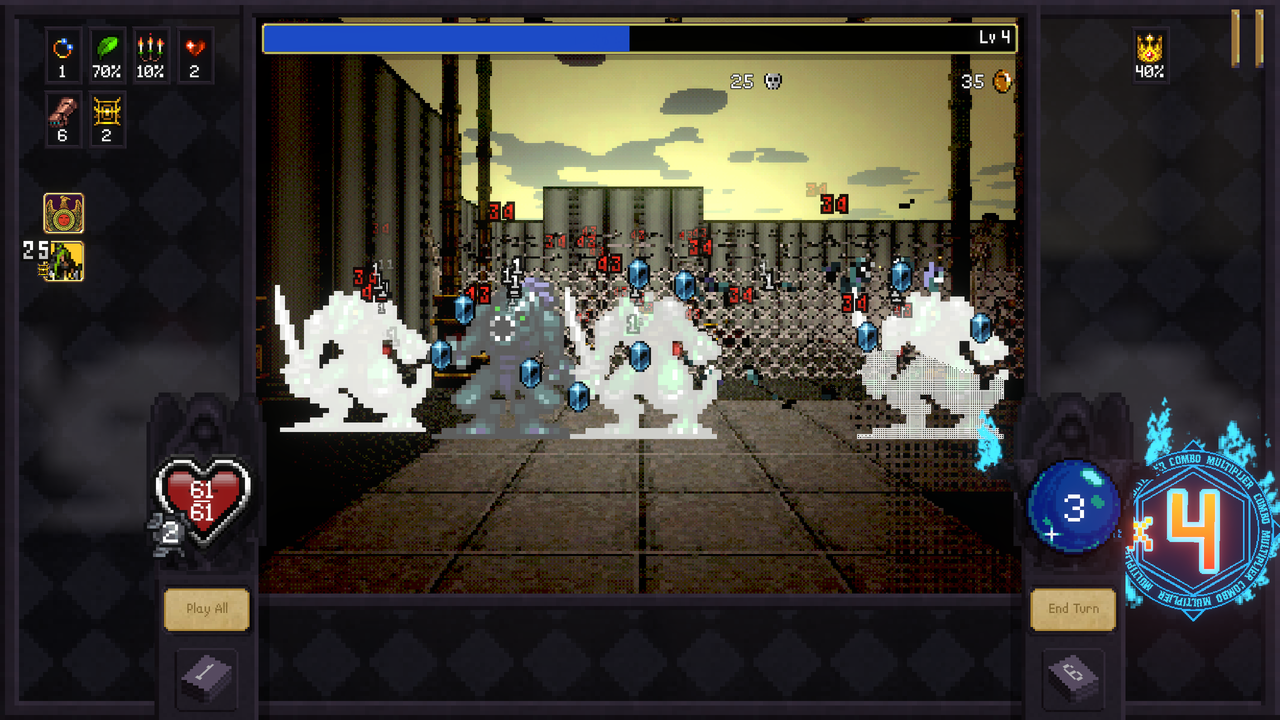
Special events are sprinkled throughout as well. Some let you sacrifice a card for mana or open extra treasure, but the best one is a little gem thief you launch your entire deck at to knock gems out of his bag. Defeating each floor’s boss takes you to the next level, and clearing the final floor’s boss completes the stage. Red Death makes his return to finish you off at the end of each run. You can skip most fights on the way to the boss, but you’d be leaving yourself dangerously underpowered. Stepping into an enemy kicks off combat, and what was a single sprite explodes into a full swarm that captures the chaotic energy of Vampire Survivors perfectly.
Combat Basics — Familiar Arsenal, Bold New Ways to Play
- Turn-based combat starts with a hand of 3 cards and 2 mana per turn
- Cards are based on weapons and items from Vampire Survivors, including King Bible, Whip, Garlic, and Attractorb
- Weapon cards deal damage while item cards provide buffs like armor, mana recovery, and card draw
The turn-based combat starts you off small—3 cards are drawn randomly from your deck with just 2 mana to spend per turn. Each card shows its mana cost in the top left, and 0-cost cards can be played freely without touching your pool. The cards themselves are pulled straight from the Vampire Survivors arsenal: King Bible, Empty Tome, Whip, Bracer, Garlic, Attractorb, and plenty more familiar items make the transition.
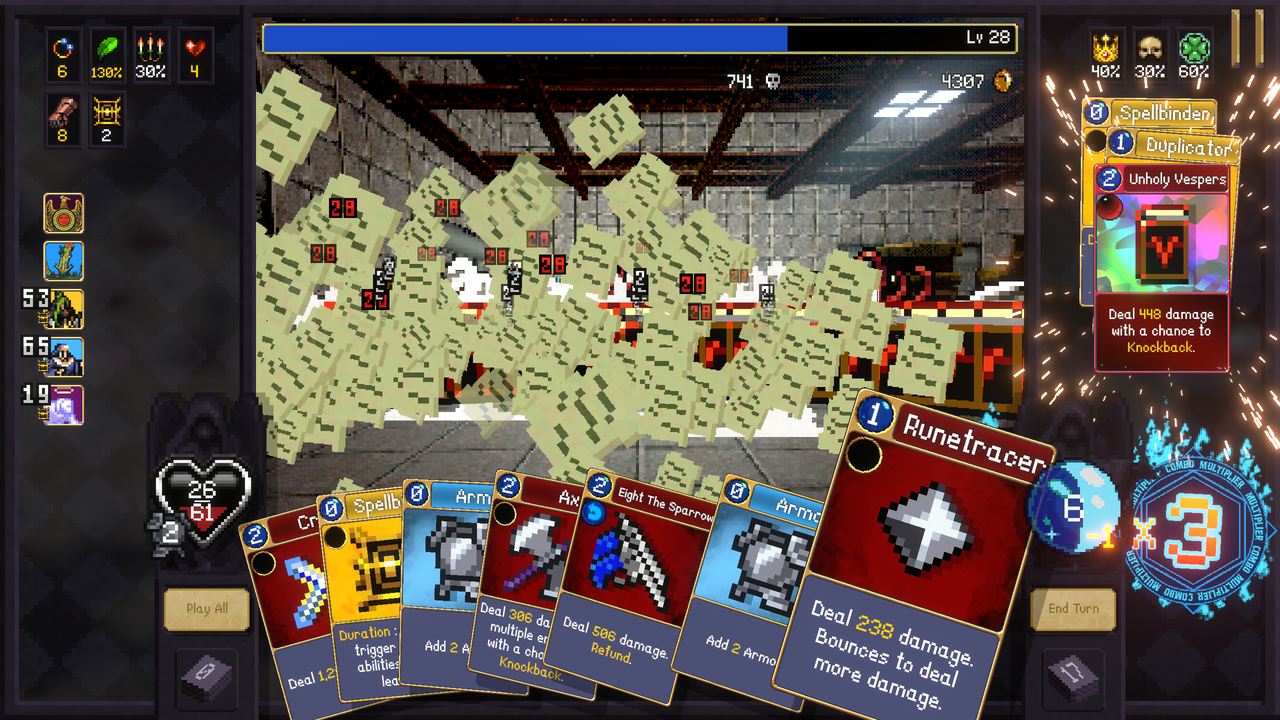
Weapon cards deal damage to the enemy swarm, while item cards provide buffs—temporarily boosting hand size, replenishing mana, adding armor, or pulling cards from the top of your deck. Everything is color-coded based on categories: Red for weapons, Blue for armor and health, Purple for mana recovery, and Yellow for miscellaneous items. Those colors are important, but I’ll come back to this later.
Combo Stack — Where the poncle Magic Happens
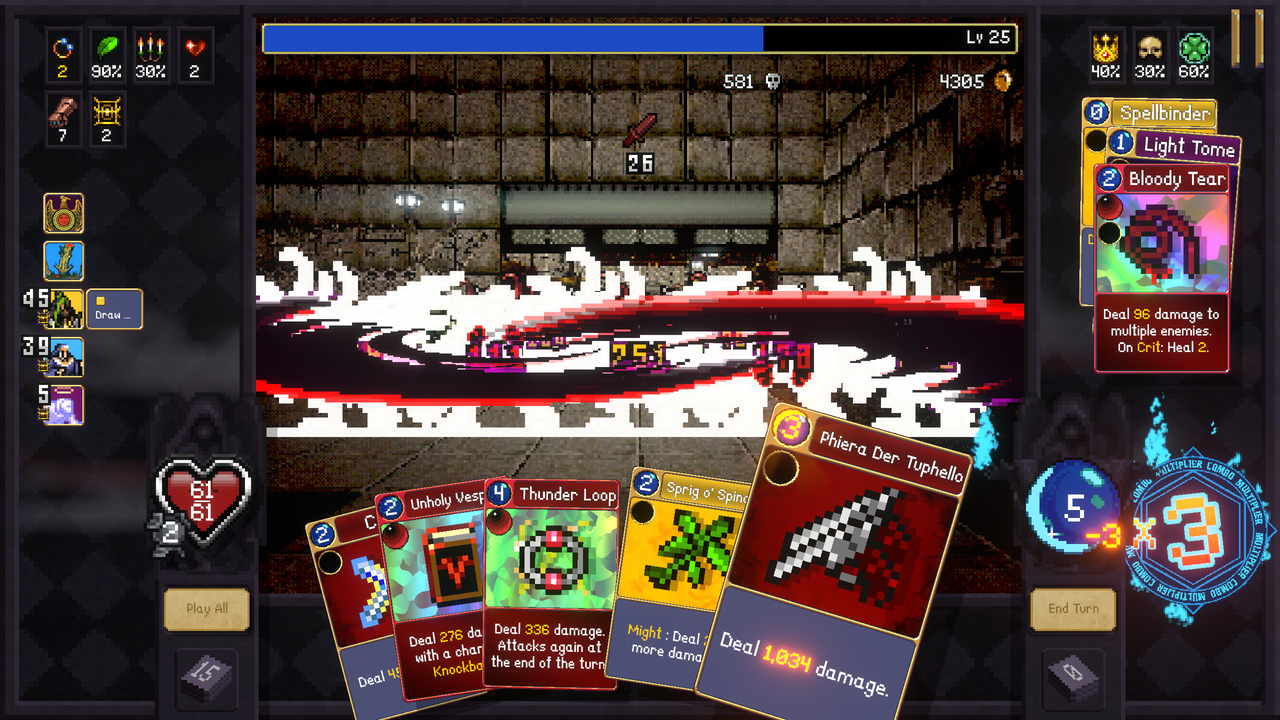
- Playing cards in ascending mana order multiply each subsequent card’s damage or effect
- Combos start small but scale into devastating, swarm-clearing chains as your deck grows
- Bracers and Empty Tomes are essential tools for extending and empowering your combos
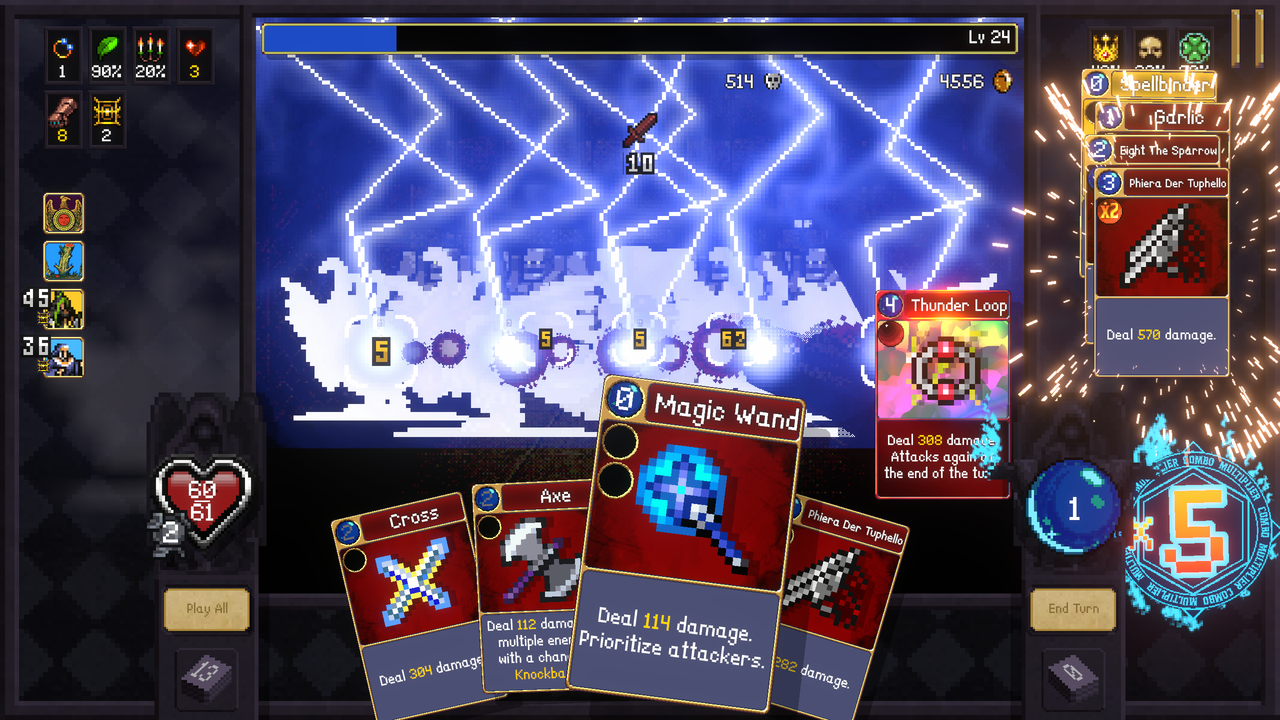
On their own, the buffs and attacks feel modest and kind of underwhelming, especially early in a run. But the real magic of Vampire Crawlers‘ combat is the Combo Stack mechanic unlocked after completing the tutorial. Playing cards in ascending mana order multiply each subsequent card’s output: a 0-cost into a 1-cost doubles the 1-cost card’s effect, followed by a 2-cost card, which triples, and it keeps climbing as you push into 3, 4, and 5-cost cards and beyond.
It’s a simple concept that becomes incredibly addictive. With only 3 cards and mostly 0s and 1s early on, the Combo Stack’s true potential doesn’t fully reveal itself right away. As you level up, pull higher-cost cards, throw Bracers in to grow your hand, and lean on Empty Tomes to keep the mana flowing, you’ll find yourself stringing together chains that can wipe out entire swarms in a single turn.
Weapon Evolutions — A Revolutionary Mechanic Returns
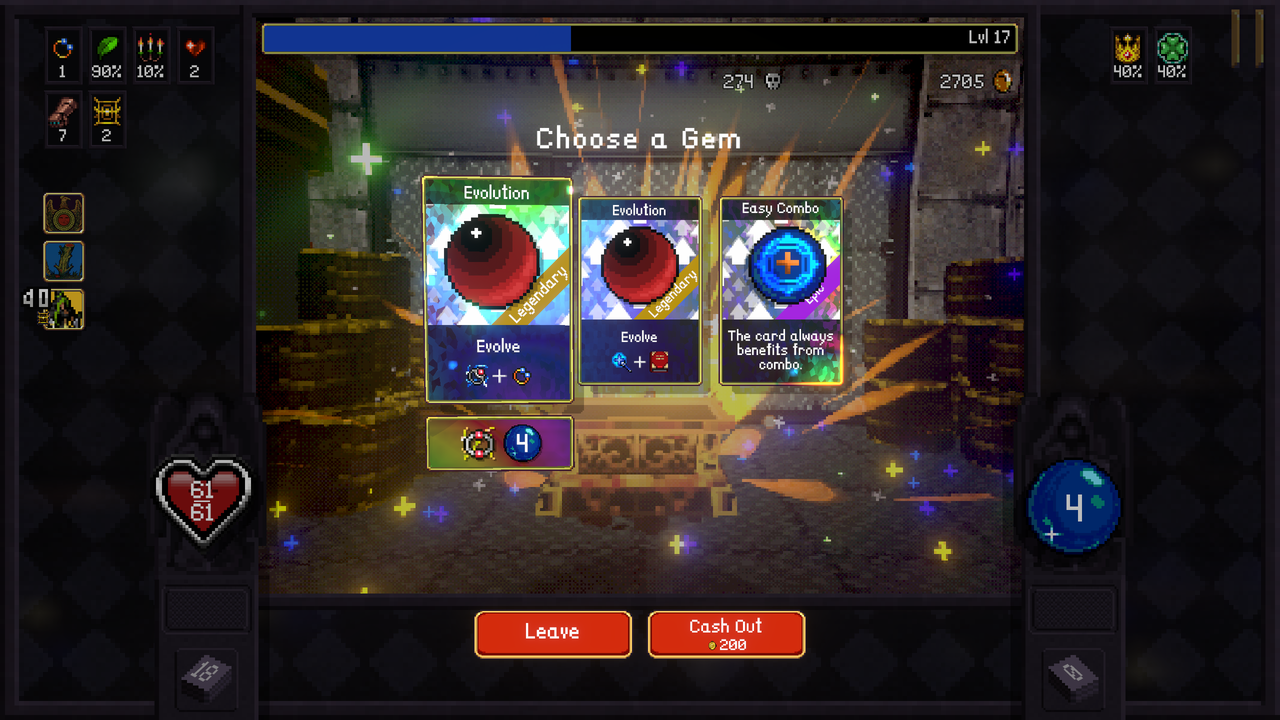
- The iconic Evolution system from Vampire Survivors returns intact
- Fusing card sets via boss treasure chests creates dramatically enhanced evolved weapons
- Evolution combinations mirror Vampire Survivors, giving veterans an early advantage
The Evolution system from Vampire Survivors is back, and it’s just as satisfying in Crawlers. Collect 2 (sometimes 3) of a matching card set, open a boss treasure chest, and you’ll fuse them into an evolved weapon with dramatically upgraded abilities. The Whip and Hollow Heart become the Bloody Tear, bringing more serious damage and healing effects. The King Bible and Spellbinder create Unholy Vespers, which boost damage and increase the knockback chance that can interrupt an enemy’s upcoming attack.
Evolutions are essential to winning, but they also just look cool as hell when played. The combinations carry over directly from Vampire Survivors, so if you’re like me and have each one memorized after hundreds of hours in Survivors, you’ll have a leg up early on. The trade-off is that the experimentation of discovering them for the first time is mostly gone. If Crawlers is your first poncle game, you’re in for an even better time.
Crawler Abilities & Bosses — Synergy & Milestones
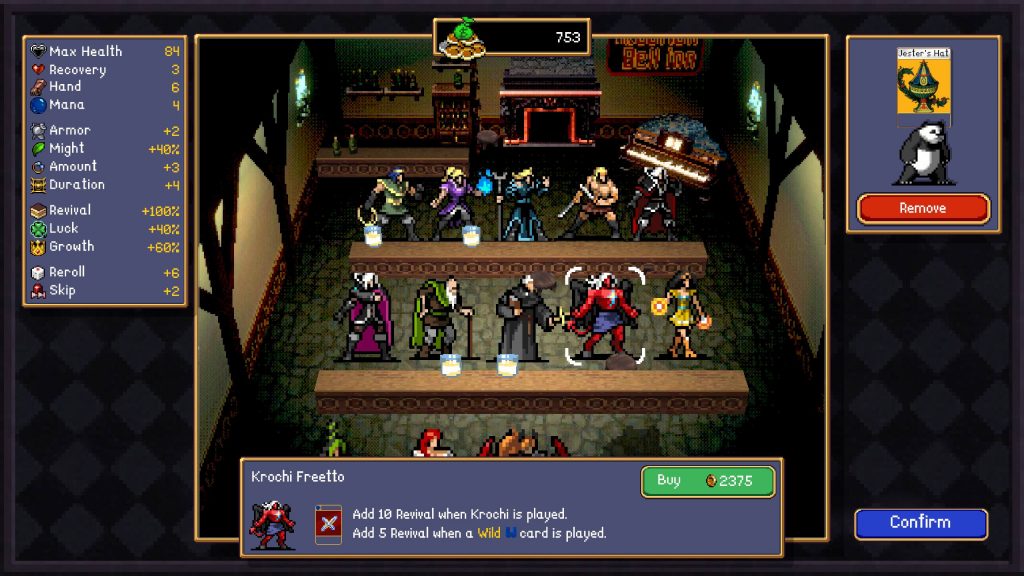
- Each Crawler card activates a unique special ability that rewards building around the color-coded card system
- Bosses insert temporary debuff cards like Confuse and Junk into your deck
- Overkill lets you keep attacking after a boss dies, earning more coins the more damage you deal
Playing your Crawler card activates their special ability, and this is where building around the color-coded system really pays off—if you play your cards right (pun intended). Antonio, the starting Crawler, grants 3 armor when played and adds 10% damage to every Red weapon card played afterwards. Imelda adds 18 XP when her card is played and boosts XP growth by 1% for the full run each time a Yellow card is played. You start of with the the Crawler card of your selected Crawler, but you can come across additional Crawlers in the dungeons to add to your build. Coordinating your Crawlers with your deck building gives you a real edge without ever feeling like homework.
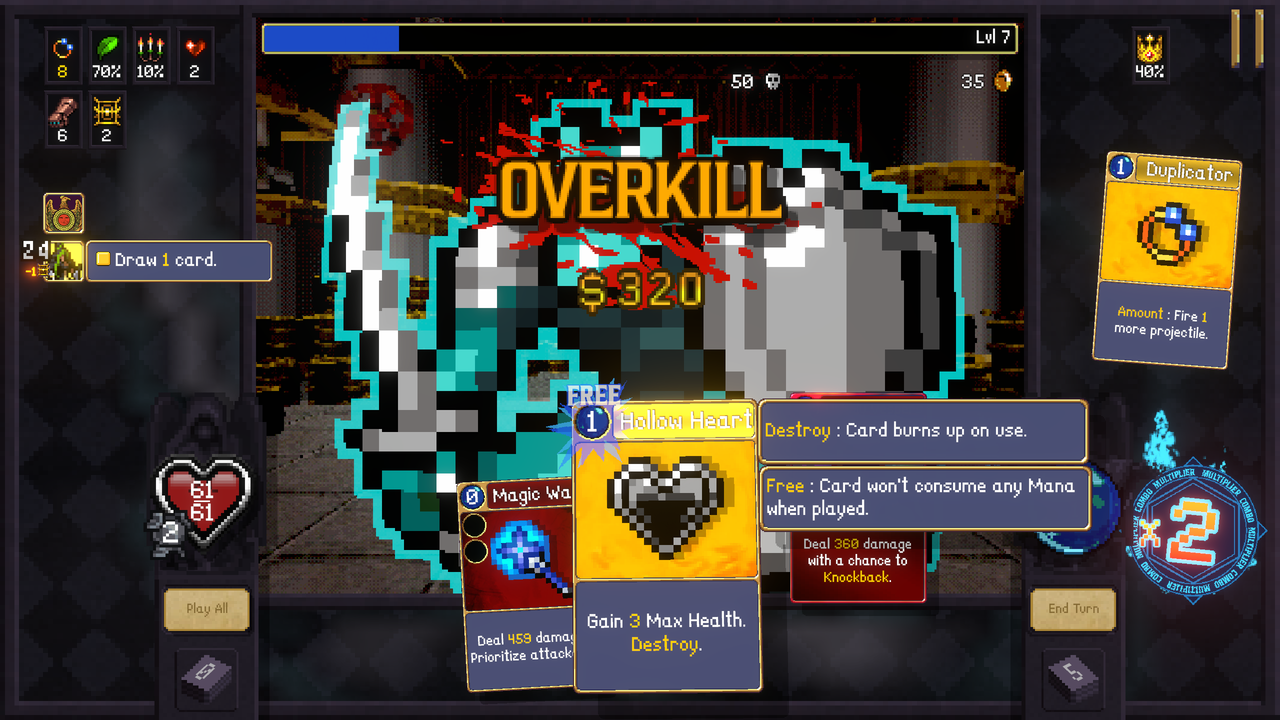
Bosses serve as the real litmus test for how well your build has come together, rather than a dominating force. They have high health pools, hit hard, and will slip temporary debuffs into your deck to throw you off. Confuse, for example, randomizes your cards’ mana costs, while Junk costs you 1 mana but at least lets you draw a card. A well-built deck will cut right through them. Later in the game, Overkill gives you the ability to keep attacking after a boss’s health hits zero, turning a dominant performance into bonus coins to fuel your next run.
Difficulty & Replayability — Become a God
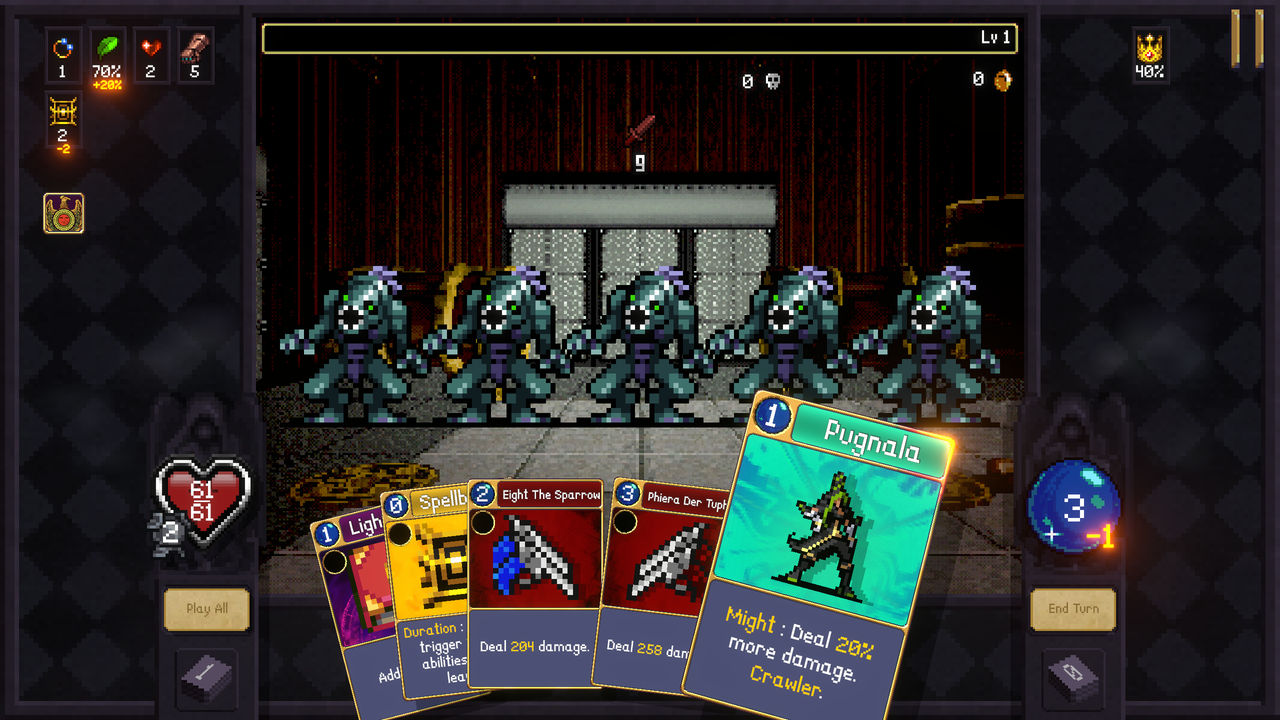
- Runs escalate in difficulty but reward patience with game-breaking, god-tier builds
- Infinite combo builds using Braces, Tomes, Wilds, and Attractorbs are achievable
Runs are challenging enough to feel meaningful, and they get seriously punishing in the late game. But the dopamine comes from those moments where your build clicks and you feel like an omnipotent god. That’s the run that makes all the failed attempts worth it, and it’s what keeps you coming back for more.
Some of the builds I’ve put together in this game are hard to describe. I had a near-perfect build where I stacked Bracers until my hand size was my entire deck, pumped Tomes until my mana hit triple digits, loaded Wild cards to extend the combo indefinitely, and let Attractorbs drag every already-played card back into my hand. I created an infinite loop that kept multiplying the combo with every cycle.
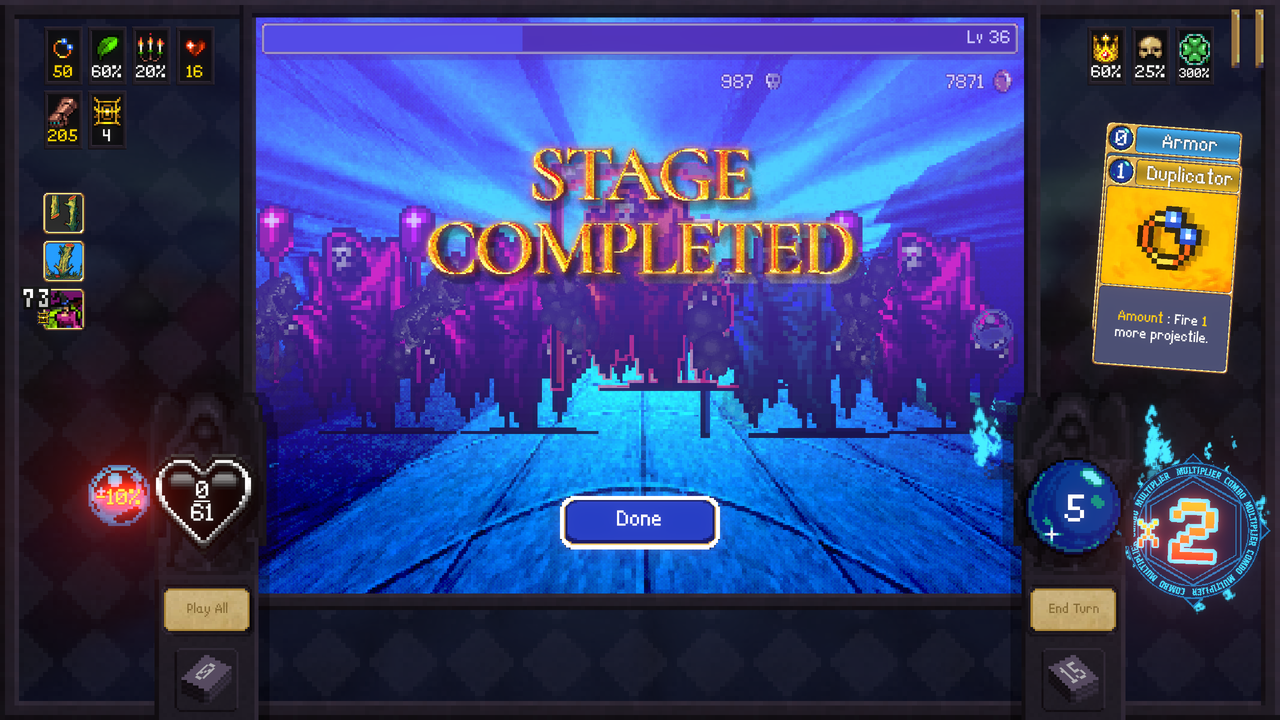
poncle, however, had the last laugh. They built a clever and genuinely awesome countermeasure to stop you from cheesing too many coins out of Overkilled bosses. It made me audibly applaud and curse poncle at the same time, but I’ll keep what it is a surprise.
The Village — An Addictive Progression System
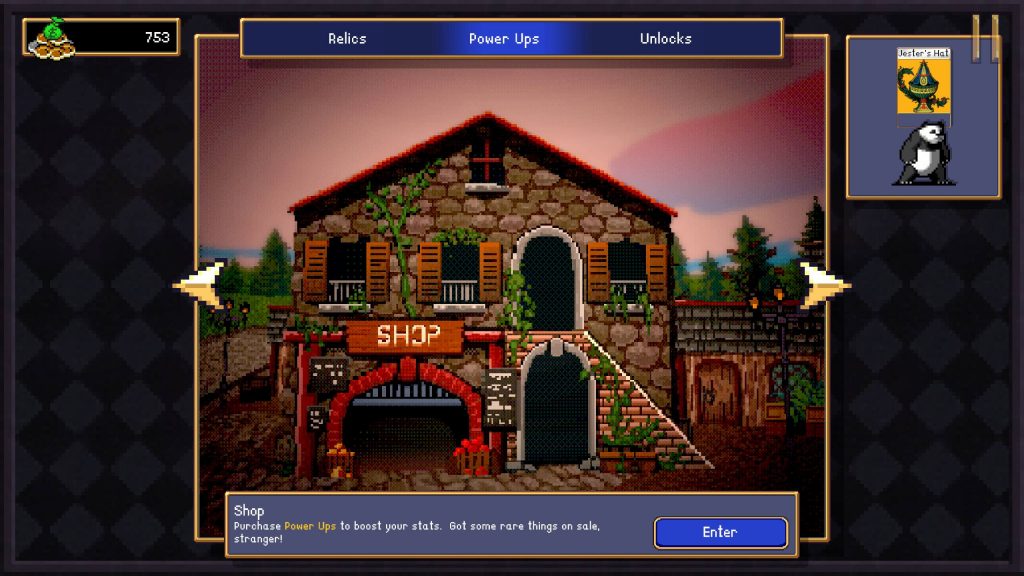
- The Village hub houses all between-run management across multiple dedicated buildings
- Arcana cards grant powerful run-wide bonuses like doubled healing or banked mana between turns
- The Blacksmith lets you socket empty Gem slots into cards for effects like double damage and copy
Between runs, you head to the Village, where each building serves as its own menu. The Town Hall tracks your objectives that unlock new cards, power-ups, and content. The objectives are also tied directly to achievements and trophies, further incentivizing 100% completion. The Shop sells Power-ups that increase your base stats permanently in exchange for coins. The Inn is where you choose your Crawler and unlock new ones. The Museum holds relics that hold unlockable QOL features, like being able to see treasure and breakable objects on your map. The Fortune Teller holds Arcana cards, which offer a run-wide bonus ability before you head out. For example, Experimental Medicine doubles your healing, while Sharp Mind lets you carry up to 5 unused mana points into your next turn.
The Blacksmith adds another layer, letting you pierce empty slots into your favorite cards. These slots allow powerful Gems to be embedded into the card. Gems are found while dungeon crawling and range from double damage to copy (which duplicates the card on play) to one that converts any card into a Wild. Between everything the Village has to offer, there’s always something to save toward, and that constant loop of improvement is what keeps you running the next dungeon.
Accessibility
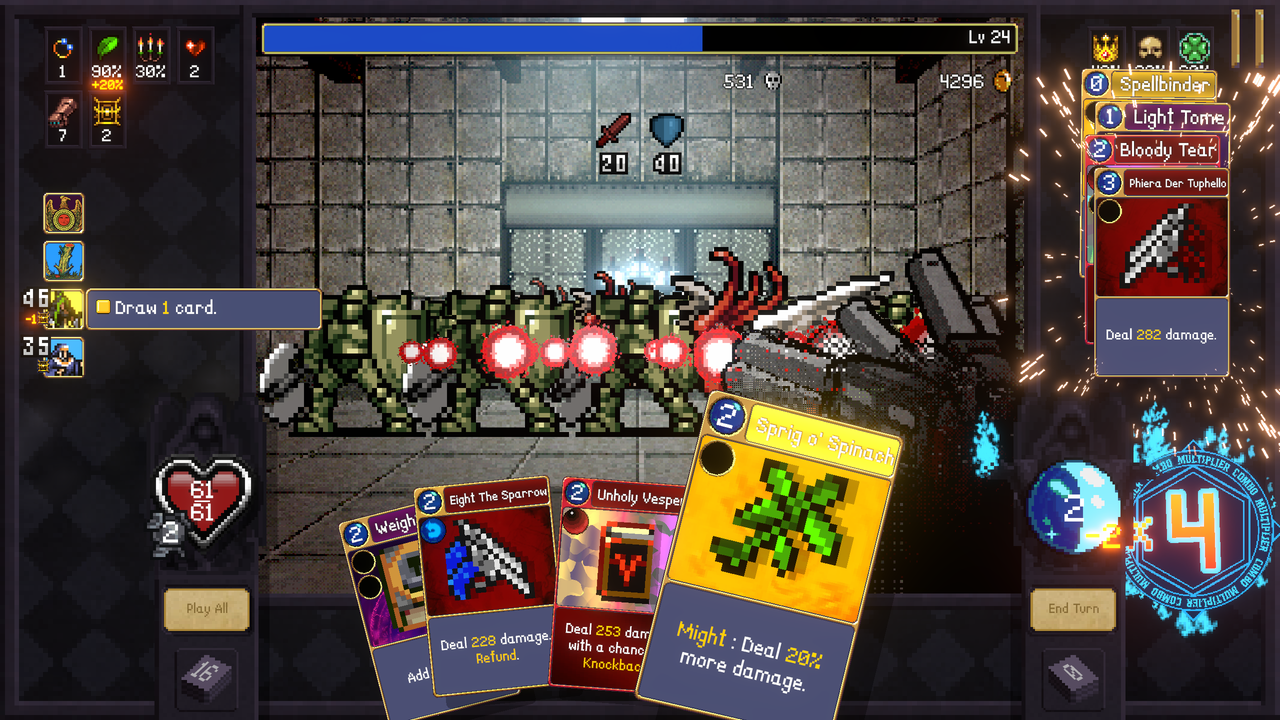
Vampire Crawlers includes a dedicated Accessibility section in its options menu with a handful of useful settings. Visual options allow you to reduce screen shake, enemy shake, and screen flashing, which is a welcome inclusion given how lively the weapon effects can get as your combos build. A grid view option and the ability to rotate the mini map with the player are also available, which should help with spatial orientation for some players. Audio sources can be isolated as well. On the input side, both keyboard and controller bindings are fully remappable.
The one area that falls short is the color-coded card system, which lacks a colorblind mode—a notable gap given how central those color distinctions are to Crawler synergies and deck building. A silver lining is that the left side of the screen does display if your Crawler ability matches the color-coded card you’re highlighting, but It’s still worth flagging for colorblind players before purchasing.
Final Thoughts
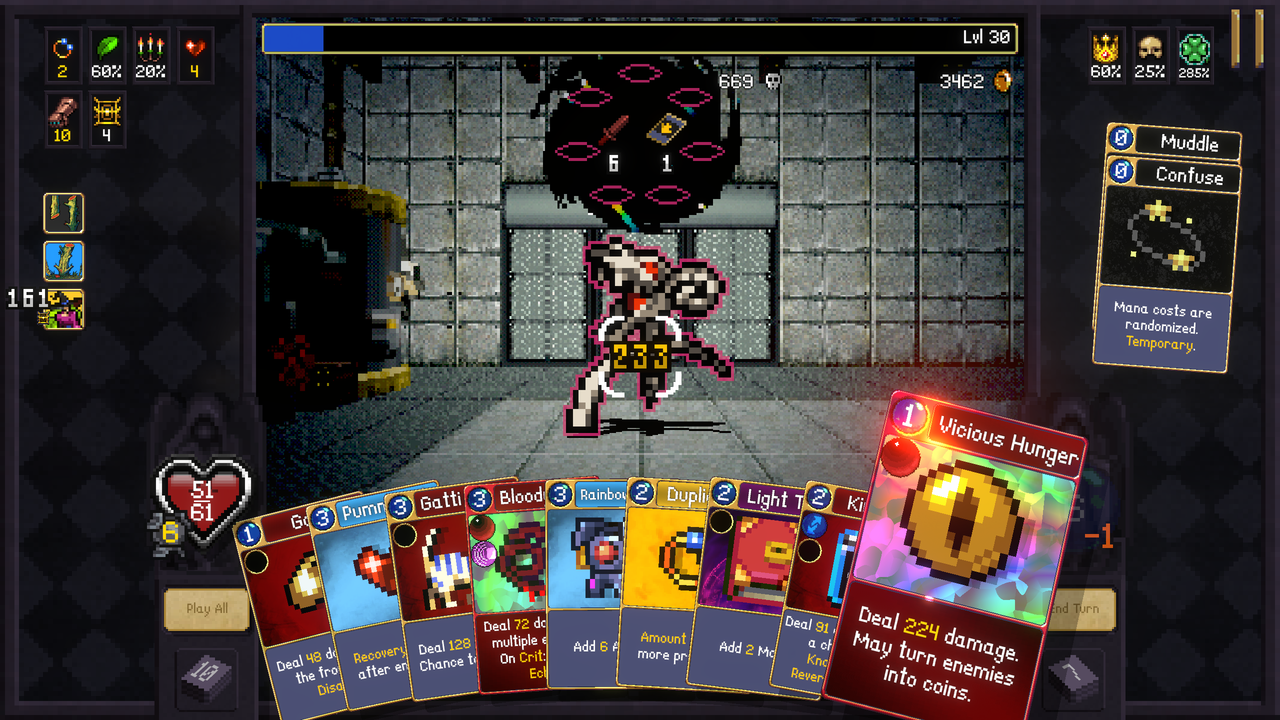
Vampire Crawlers is exactly the kind of follow-up you hope for from a studio like poncle. Taking everything that made Vampire Survivors so addictive and making it work in an entirely new genre is no small feat. Yet, they pull it off here with the same knack for excellent game design that made the original a phenomenon. The visual effects and soundtrack are tantalizing, the dungeon crawling adds a fun element in between the action, and the deck-building depth and addictive progression system will keep you locked in. The shared Evolution combinations from Survivors take some discovery away for veterans, but it’s a minor drawback for an otherwise outstanding experience. Between Xbox Game Pass and the $9.99 price point, Vampire Crawlers is the easiest recommendation of the year.
Final Score: 9/10
Pros
- Combo Stack mechanic is brilliantly addictive and turns deck building into pure dopamine
- Weapon Evolutions return with all the satisfaction and even flashier visual flair
- Crawler abilities and color-coded card synergy add genuine strategic depth
- Robust Village meta-progression makes every run feel meaningful
- The visual design and soundtrack arguably surpasses Vampire Survivors’
- Tremendous value at $9.99
Cons
- Reused Evolution combinations from Vampire Survivors lose some of the experimental magic for veterans
- Missing some of the surprise narrative moments of Vampire Survivors, though the gameplay easily carries the experience
