
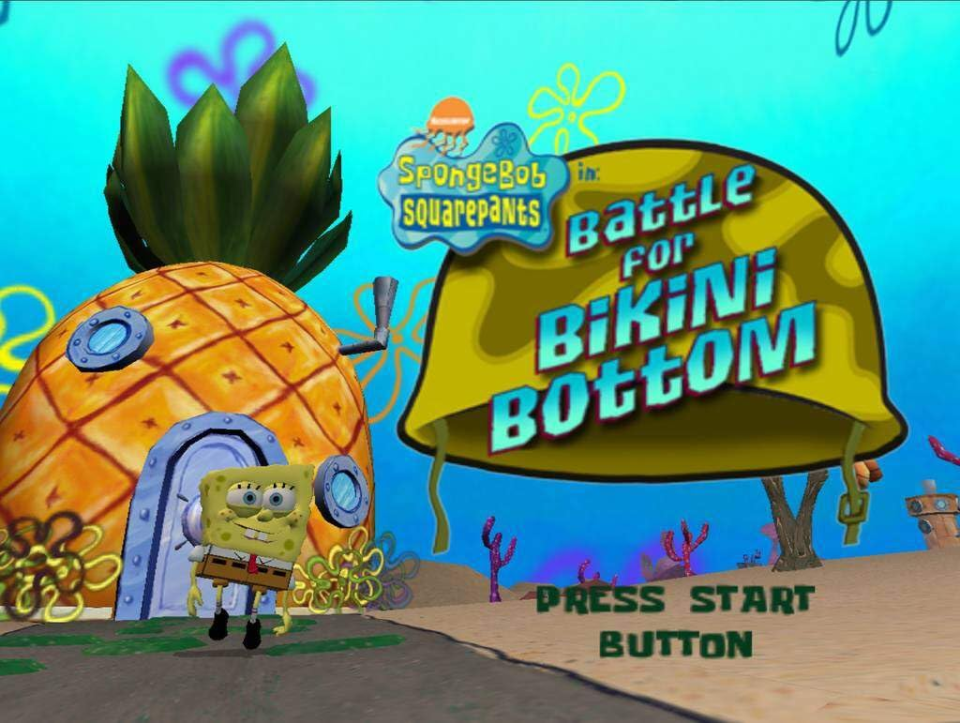
What Is Spongebob Squarepants: Battle For Bikini Bottom?
Spongebob Squarepants: Battle for Bikini Bottom is the third title developed by Heavy Iron Studios, previously an in-house development studio founded in 1999 by THQ Games. Born out of the relationship THQ had with Nickelodeon in the late 1990’s, specifically from the success of games like 1998’s Rugrats: Search for Reptar. That success led Nickelodeon to continue their working relationship with THQ well into the 2000s. This relationship gave THQ the console and handheld game rights to SpongeBob SquarePants in October 2000.
Spongebob Squarepants: Battle for Bikini Bottom was the third Spongebob game to hit home consoles after 2002’s SpongeBob SquarePants: Revenge of the Flying Dutchman. Developed in roughly one year’s time, Battle for Bikini Bottom was the first Spongebob game to be developed by Heavy Iron Studios, following up on the prior title’s gameplay and reinforcing it into a true collect-a-thon platformer, with hub worlds, side collectables, gated pathways, unlockable abilities, and so on. All things considered, its short development time didn’t stop the title’s long-term legacy as one of the best licensed games of all time.
Developer & Publisher // Heavy Iron Studios & THQ
Platforms // Gamecube, PlayStation 2, XBOX, Windows
MSRP & Release Date // $39.99, October 29th, 2003
Reviewed On // PlayStation 2, October 27th, 2026
Ah~ Bikini Bottom…
The “battle” in Battle for Bikini Bottom is as follows: Plankton created a device that endlessly spits out robots in order to take over Bikini Bottom, with one flaw: he forgets to set the device to “obey”. This leads to the entire town being ransacked by robots, and only SpongeBob, Patrick, and Sandy are willing to do anything about it.
The game hits you with the charm we’ve come to know and love from the early seasons of Spongebob very quickly. As expected, it never delivers a dull punchline throughout its runtime. The rare cutscene will have all the original actors (sans Clancy Brown’s Mr. Krabs and Ernest Borgnine’s Mermaid Man) firing off bits in perfect Season 1 cadences. In particular, the stand-out moments are closer to the end of the game. Other than that, the game reinforces itself with a healthy dose of visual humor in both the assets and enemy designs, with a surprisingly desaturated color palette. You can miss the Rock Bottom bus, rodeo swing over piles of manure, and watch as Hans the Hand grabs you and puts you back on solid ground should you ever go out of bounds.
Why Would You Send Spongebob Off To War?
The bulk of the game follows you as mainly Spongebob, starting off near his Pineapple and working your way down to the Chum Bucket through multiple gates. The humble golden spatula, the main collectible of the game, serves as the key to these gates. You work through the main hub world in chunks, with each chunk being host to around 3 separate levels with 8 golden spatulas a piece.
Seeing as the game released well into the real show’s third season, the pool of locales the game pulled from was fairly basic to start. Goo Lagoon, Jellyfish Fields, Kelp Forrest, but where the dev team shined was in the places where it needed a little more creative liberty.
Bikini Bottom Tourism In Rise Alongside Robot Assault
Spongebob SquarePants: Battle for Bikini Bottom’s levels are, unfortunately, very linear. But the one thing they remain is unique. While some levels seem cut and dry, others can take a pretty fun concept and run with it. Places like Downtown Bikini Bottom, The Mermalair, and even a completely out-of-left-field dream world in the later portion of the game had pretty lasting impressions on me as an avid fan of the show when I was younger.
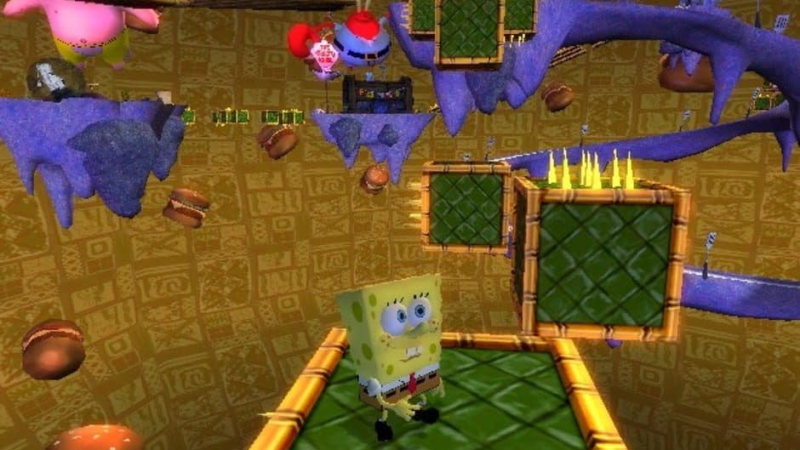
That being said, you’ll find a discouraging lack of reason to return to any stages after the first pass through. Unlike many of its contemporaries like Super Mario 64 or Banjo Kazooie, Battle for Bikini Bottom is smart enough not to kick you out after collecting a golden spatula. However, sadly, it’s often unable to give you anything you can’t do until you have a bigger toolkit.
Spongebob Squarepants: Battle for Bikini Bottom Level Design
The level design is, as stated previously, very linear, which to some can be an upside. Not everyone wants to play a game where you have to scour every inch of a place to find a MacGuffin. But to me, the worth of a collect-a-thon isn’t always in how much you can get in one sitting and how easily, however, in those Metroidvania-esque elements of building on an existing level to give it more depth.
The best use of that kind of game design can be found in Patrick’s socks, a second-tier collectible hidden throughout all the levels with a much bigger degree of hair-pulling secrecy. However, you’ll only find them to be a fulfilling venture if you’re shooting for 100% completion.
In that sense, Battle for Bikini Bottom is closer to Super Mario 64, but not close enough. The closest the game gets to creating an objective with some essence of backtracking is in Downtown Bikini Bottom, a task named with all the subtlety of a jackhammer: “Come Back With the Cruise Bubble”.
Levels often lean into that linearity, however. Most lead into a boss fight or major set piece like the Mermalair’s Killer Prawn fight or Rock Bottom’s Museum. But rather, the game is focused more on platforming challenges, puzzles, and combat than its exploration. Consequently, if I had roughly a year to make a Spongebob Squarepants game, I’d probably find myself doing the same thing.
1% Sponge 99% Bubble
Heavy Iron Studios did what most teams did with Spongebob when it came to developing a move set around the character. They focused heavily on his malleability and bubble-blowing. Spongebob starts the game with the standard array of a double jump, a single attack, and a ground pound move. Generally speaking, the controls are impressive in their responsiveness. All playable characters feel good to play as, the sound design makes jumping satisfying and carries the rest of the move set. Attacking enemies often sends them flying so far away you’d be surprised to know they weren’t made in a bomb factory, for bombs.
The most notable addition to Spongebob’s arsenal is an additional bubble power that sends you straight up with a Viking helmet made of- you guessed it- bubbles. New abilities serve as rewards for each major boss fight. First, you get the bubble bowl ability; this ability allows you to throw a bowling ball. Then comes the aforementioned bubble cruiser, which lets you guide a missile with first-person aiming into whatever you may need to. While the bubble bowl ability gets a lot of use, considering its placement towards the beginning of the game. In contrast, the cruise bubble doesn’t get as much mileage due to its introduction late into the game.
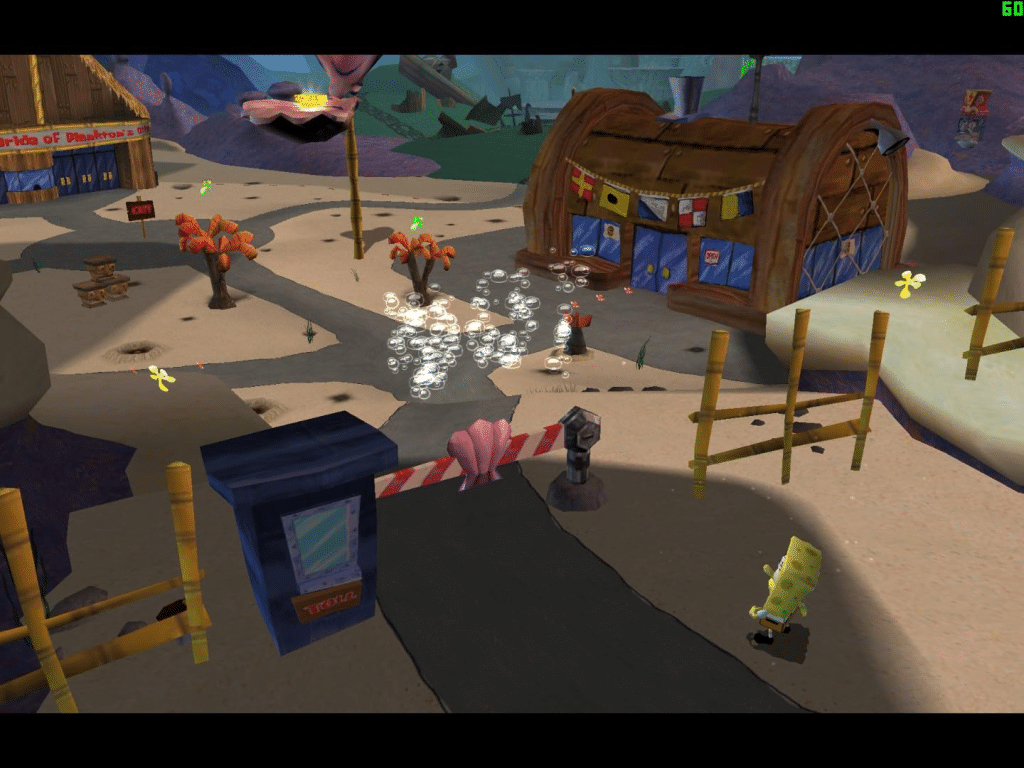
In this case, Spongebob, even as one of three playable protagonists, is the only one to gain any additional abilities throughout the game. With the lack of any different movement options being a worthy note, the best character to play as by far is Sandy. In addition to her double jump, she’s the only character that can hover (a godsend in these early 2000s platformers) and swing on ropes. Undoubtedly, this gives much-needed movement options to the game’s somewhat stunted platforming.
If Someone Made A Robot Clone Of Me, I’d Probably Want It To Be Strong Too
While the game features a good variety of basic boss battles baked into the stages, they all have something that makes them unique, be it their utilization of specific stage hazards or purpose in the broader level’s ongoing plot. The major boss fights are the ones that take the cake. However, all of them take the form of robot versions of Sandy, Patrick, and, for the final boss, Spongebob.
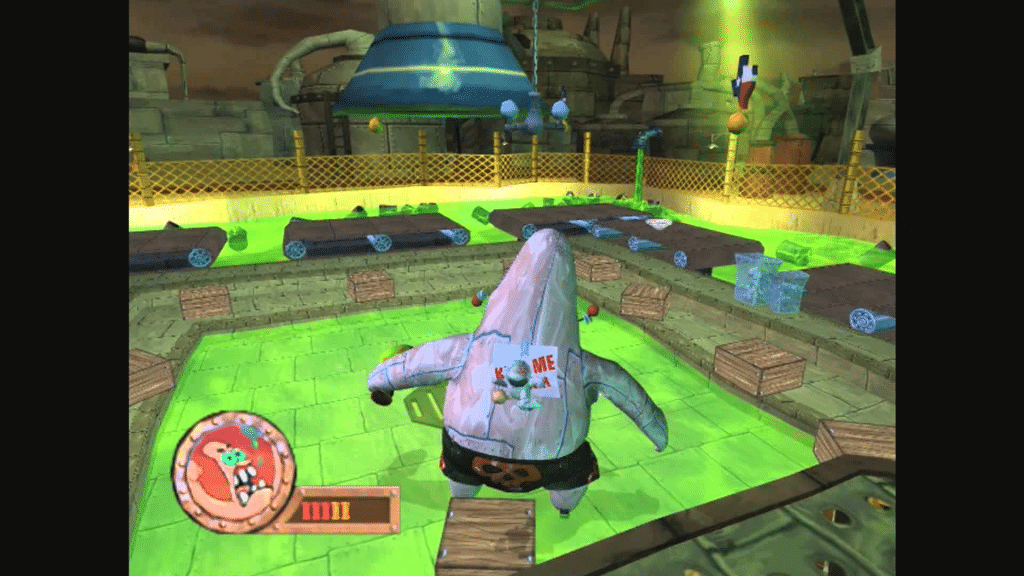
These fights go fairly above and beyond, and as a kid I was honestly somewhat scared of them. What fights like Robot Sandy lack in any particular depth, they make up for by playing the whole thing for laughs. The entire fight being Spongebob and Patrick in a tag-team wrestling match with a robot squirrel ten times their size. Easily the standout fight of this game is the final match with Robot Spongebob, the fight is equal parts spectacle, creative, and for it’s worth, decently paced. Who expects their 2000s licensed mascot platformer to have a two-phase final boss?
Final Thoughts on Spongebob Squarepants: Battle for Bikini Bottom
In summary, Spongebob Squarepants: Battle for Bikini Bottom is an easy game to stand back at and pick apart. Its insanely quick development period is easy to point to for most faults or shortcomings you can find in it. Critics were fairly apathetic to the game upon release, whereas nowadays it’s lauded for its cult status as one of the best licensed video games ever made. I find myself believing and buying into that interpretation as well.
To put it differently, for the fan of both platformers and Spongebob, there are many things to love about this game. Be that its writing, creative and original level ideas, unbelievably catchy soundtrack, responsive gameplay, and most of all, its undeniable charm. It’s painfully obvious why THQ Nordic would remake the game in 2020, with the much more accessible SpongeBob SquarePants: Battle for Bikini Bottom – Rehydrated. Even if the game’s journey back into cultural relevance led to speedrunners finding that smearing ketchup on the disc makes any% speedruns much easier, I’m sure that’s what Spongebob would have wanted.
Spongebob Squarepants: Battle For Bikini Bottom (PlayStation 2)
Pros
Responsive Platforming
Charming Writing
Great Boss Battles
Fun Enemy Variety
Surprisingly Great OST
Tongue Sliding
Cons
Linear Level Design
Lack Of Movement Options & Upgrades
The Mermalair Rolling Ball Room
