
What is Carombole?
Caromble is an ambitious project, as it uses the block breaker formula and adapts it in wild ways. Released on Steam as an early access title, the team at Crimson Owl Studios finishes the project with new content and more. But does it break through all the bricks? Or are these too hard to smash? After playing through the adventure and playing some of the new Skill Levels, I have a lot of respect for the ambition on display, even if the steep difficulty ceiling challenged me more than I would’ve liked.
Publisher/Developer: Crimson Owl Studios
Platforms: Steam (PC)
Price: $12.99
Release Date: August 28th, 2015 (Early Access), April 22nd, 2026 (Full Release)
PC Specs:
CPU: AMD Ryzen 9 6000 Series
GPU: AMD Radeon 6850M XT
RAM: 32GB
It’s Time to Caromble! – Premise
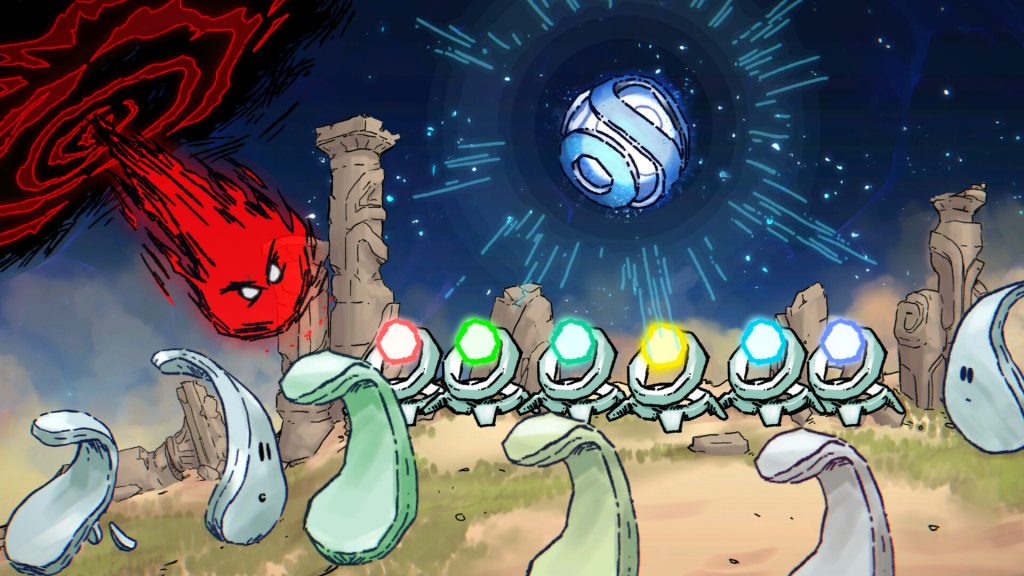
The game’s story mode opens with a comic-book cut-scene, setting the scene for a group of protectors of the Arkatrons. These are powerful abilities used to defend worlds. However, an ancient treat reemerges and steals the Arkatrons.
Two of these protectors brave the cosmos to regain the Arkatrons. This premise is simple, but it’s effective in getting players right into the action for the game’s six-chapter story mode.
Dynamic Block Breaking – Gameplay
The gameplay of Caromble is deceptively simple. Controlling a padel to hit an incoming ball with either the Mouse or analog stick/D-Pad on a controller, you break blocks. But the game has more nuanced mechanics. They include charging your paddle to make the ball smash through denser blocks, controlling where the ball goes by gently hitting left or right, which moves it in the opposite direction. Or how there are Blue Power Ups that can grant Aim Assist, a Bigger Paddle, and even extra balls & lives.
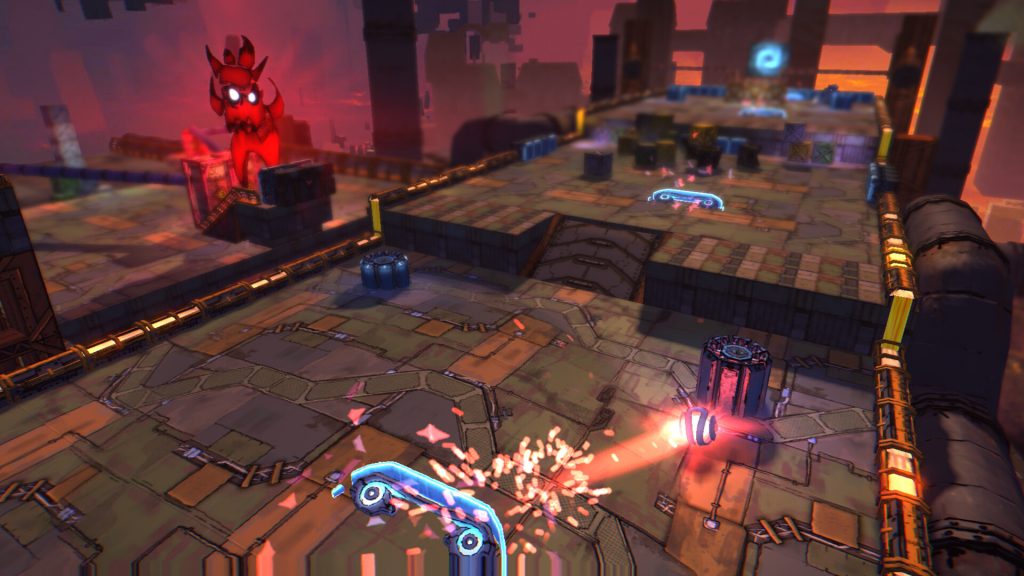
However, there are the Red Power Ups, changing the perspective (behind the paddle or pixelating the screen), speeding up the ball(s), and even making your paddle smaller. Early on, the Red Power Ups were fun mix-ups to the core gameplay, but as level design became more involved, they became frustrating roadblocks.
Collecting the Red and Blue Power Ups involves moving the paddle and then landing on it. So, it’s a matter of reaction time whenever you get the benefits and negatives of those abilities. The core gameplay is supported by unlockable abilities, keeping things fresh and engaging throughout.
Elemental Pinball – Arkatron Abilities
These abilities, called Arkatron’s, are unlocked after clearing each world. They are activated by your ball hitting them in the stages. They range from a Time Slowdown ability (granting better control over your paddle and freezing time, the Shoot ability (a projectile kinetic bomb that sucks in blocks and blows them up), and several more.
These abilities lean into the game’s expansive level design, forcing you to be mindful of them as you progress through the adventure. While I enjoy some of these abilities, others frustrated me due to their odd, charged aiming mechanic (specifically the Shoot ability).
A Ball of Different Talents – Level Design
The core gameplay of Caromble is solid, but what really makes the game unique is the block breaker’s wild and creative level design.
Every single level throws something new to the player. Gravity mechanics, paddles across multiple floors, and hitting switches in order are some examples of this. The most impressive thing is that most of these are in the background layers of each level, with players getting closer to them after sending the ball through portals.
In many ways, Caromble uses the Block Breaker genre’s canvas to craft genuine puzzles and adventure-like challenges to overcome. I was taken aback by some stages, which can last upwards of five minutes or longer. For a genre of games that have bite-sized experiences, adapting that format into something grander is impressive. This extends to the boss encounters.
Red vs Blue – Boss Battles
Concluding every level is a boss encounter against the main bad guy, trying to hit him three times before landing the final blow. These challenge the player to use all the skills they learned throughout a given level, alongside smartly utilizing power-ups and abilities, to land those blows against the boss.
Some encounters can be genuinely fun, fair, and those victories are well-earned. However, a sizable number of encounters felt drawn out and took what should’ve been a shorter level into a needlessly longer one. Most egregious is the fact that if you don’t hit the boss fast enough, they regenerate health, forcing you to whittle down their three hit points again, then landing the final blow.
The boss’s amount of health does not change with the difficulty options either, so even when playing on Easy Difficulty, these issues are still apparent.
Head Banging – Difficulty & Accessibility
For Caromble to achieve its level of ambition in level design and boss encounters, the game has multiple difficulty options. Each one offers a different number of extra lives after losing your initial two. This is called the ‘Mercy’ option, with each difficulty option offering a different number of extra lives.
However, I felt the only valid one was Easy Difficulty. Granting the player 99 lives, the game gives you more than enough chances to get through the game’s tough challenges. At least, that’s what I thought going into the adventure.
After playing through a sizable amount of Caromble’s main story levels, I got increasingly frustrated by the game’s level design, as it demands a lot from the player mechanically.
The ‘Mercy’ difficulty only giving you more lives isn’t enough. It’s putting a Band-Aid on the genuine design issue of only having two initial lives. Enabling some of the power-ups (like Aim Assist or Instant Charge) when that’s active would’ve gone a long way in making the harder levels more enjoyable. More so since the game already disables your Score once ‘Mercy’ is selected.
Testing Those Talents – Skill Levels
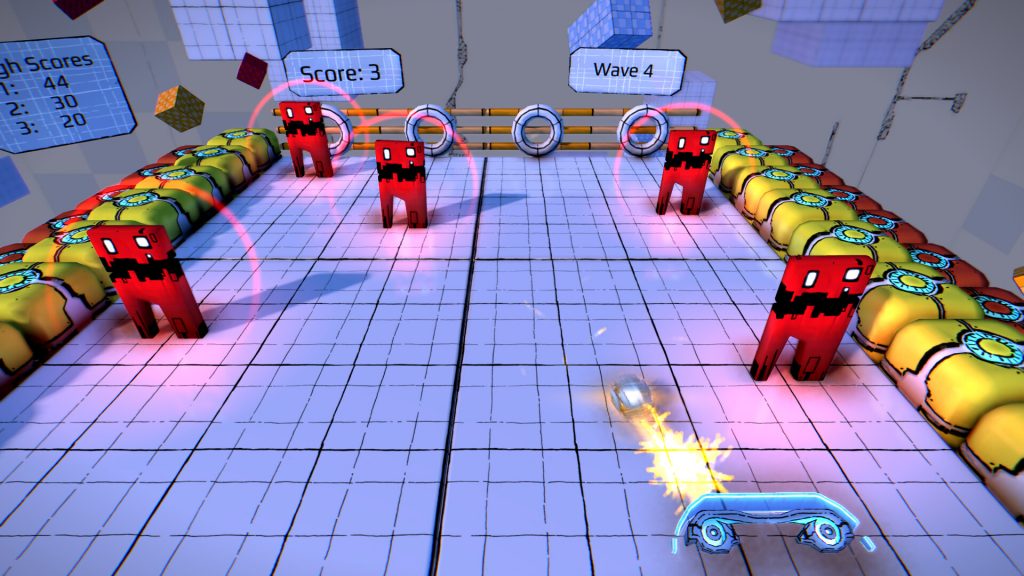
Even with the great difficulty ceiling, players playing through story mode will unlock a sizable amount of ‘Skill Levels’. These levels give players one life, tasking them to complete a challenge. It could be a race to get your ball to the furthest end of a board, or using multiple balls at once to get the highest score.
I was unable to complete any of these challenges during this review process; however, the lack of a life system here isn’t an issue. It’s a post-game bonus for players who understood Carombles deeper mechanics and flex their mastery of those skills.
The Future is Here – Presentation/Audio
Visually, Caromble has a distinct look. Its 3D graphics, combined with comic-like shading for the main villain and level objects, make the game stand out. The game gradually introduces more unique environments, such as the initial city area, industrial construction docks, and more, as the adventure progresses.
This is supported by solid sound design, with every broken block, brick, or object having an impact. Other sound bites, like the charged-up paddle, are effective too.
The music sadly isn’t that catchy, though the game’s limited dialog did make me smile. I love the opening, with the game proudly saying ‘This is Caromble!’ when it boots up.
Closing Thoughts on Caromble
When innovating a genre known for pick-up-and-play fun, it has to make that work for a multiple-hour-long adventure. And the difficulty spikes and lack of accessibility options harm the bold ambition of Caromble‘s core game design.
It’s wild, inventive levels that continually mix things up, combined with new abilities in each world, that keep things fresh and engaging. So even though I had fun with my time with Caromble, my frustrations with the game’s great difficulty soured the experience.
Score: 7 out of 10
Pros:
- Deceptively simple gameplay hides a deeper experience.
- Abilities and Power-Ups keep things fresh throughout.
- Mostly engaging boss encounters.
- Distinct visual style with varied level themes.
- Solid sound design
Cons:
- Difficulty Options don’t do enough to combat the high skill ceiling
- The game’s level design demands too much from the player sometimes
- Boss encounters can be unfair
This game was reviewed using a code provided by the publisher.
