
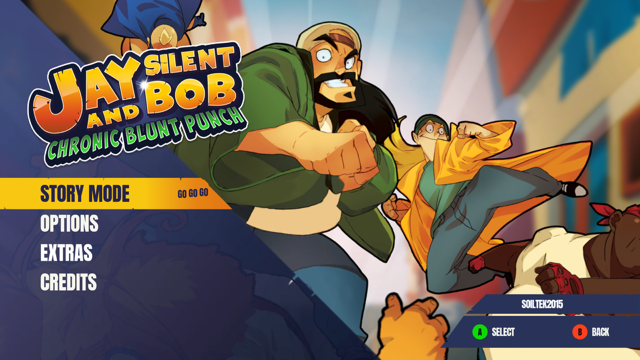
What is Jay and Silent Bob: Chronic Blunt Punch?
Jay and Silent Bob: Chronic Blunt Punch presents itself as a retro-style beat-em-up built on the chaotic energy of the View Askewniverse. It looks like the kind of game you can pick up, have some fun with, and put down without much friction.
On paper, it sounds like the perfect short-session game. Something quick, funny, and easy to jump in and out of. In practice, it struggles to deliver on that promise.
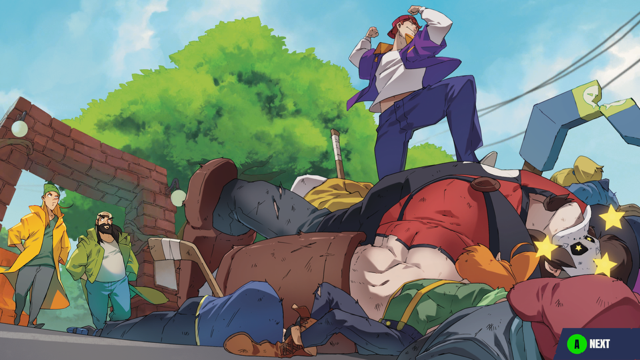
Developer: Interabang Entertainment
Publisher: Atari, Digital Eclipse, The MIX GAMES
Platform: PlayStation 5, Xbox Series X|S, Nintendo Switch, PC (Steam)
MSRP: $19.99
Release Date: April 20, 2026
Reviewed on Xbox Series X
Story/Narrative
The story follows Jay and Silent Bob through a chaotic, dimension-hopping adventure filled with bizarre enemies, returning characters, and constant callbacks to the broader View Askewniverse. Much like Kevin Smith’s films, the narrative exists mostly as a vehicle for jokes, references, and absurd situations rather than emotional storytelling. The ending fits that same tone. It delivers spectacle and fan service more than a satisfying narrative payoff, though by the finale, the combat systems finally begin to click in a way the earlier portions of the game struggle to achieve.
Does Jay and Silent Bob: Chronic Blunt Punch Respect Your Time?
On the heels of just having reviewed Replaced, another side scroller, I expected a chill, wacky beat-em-up I could play in short bursts. That’s the lens I bring to most games, especially with limited time. It doesn’t meet that expectation.
Progression is tied to completing full levels that can run 15 to 20 minutes. If you die, you start over. There are no meaningful checkpoints or mid-level saves. You can revisit cleared levels, and as you progress, you unlock additional characters for your roster. On paper, that suggests replay value.
In practice, the game never clearly explains why you should go back or how those characters meaningfully change your approach. That lack of clarity makes progression feel flat, even when the system exists. The result is friction instead of momentum. The game asks for repetition but rarely rewards it in a way that feels intentional.
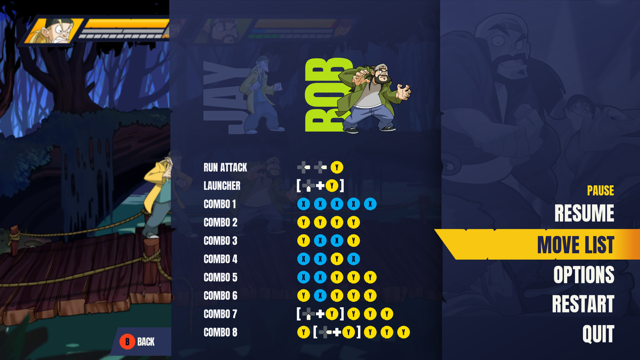
Gameplay and Combat Breakdown in Jay and Silent Bob: Chronic Blunt Punch
The combat has a solid foundation. You can feel the influence of classic fighters like Street Fighter II in the move sets.
Jay leans into technical inputs with uppercuts and combo chains. Silent Bob plays more like a heavier character with spinning attacks and crowd control tools. When attacks connect, the game feels good. The problem is consistency. Combat sits in an “almost fun” space and never fully clicks.
Blocking and dodging lack responsiveness. Invincibility frames are not clear. As enemies stack up, fights shift from controlled to overwhelming.
Enemy hit detection adds to that inconsistency. Hitboxes feel unreliable, with attacks sometimes connecting cleanly and other times missing when they look like they should land. That lack of clarity makes encounters harder to read and learn. It feels like it should flow, but rarely does. And when it doesn’t, it feels like the game is working against you instead of with you.
There’s also a disconnect in how the game teaches its systems. At certain points, you’re given a throwback challenge that lets you use a wider range of moves on a destructible object, similar to the bonus stages in Street Fighter II. Those moves, however, don’t translate cleanly into actual gameplay. It briefly shows what combat could be, then pulls it back.
To its credit, the system does open up later. Once you build momentum and carry power-ups deeper into a run, the combat starts to feel more complete. Entering fights with supers and assists ready adds a layer of control and spectacle that’s missing early on. Some of these supers lean into classic arcade energy, with multi-hit sequences and screen-filling attacks that echo games like Super Street Fighter II. In those moments, the game finally delivers on its promise. It just takes too long to get there, and it doesn’t happen consistently.
Difficulty Without Support
Some of the difficulty comes down to execution. That part is fair. What’s missing is support. There are no difficulty options. No way to tailor the experience. The move list also lacks clarity. It labels combos but doesn’t explain how to use them in practice. That creates a gap between knowing and doing. Learning feels like work instead of progression.
That same lack of clarity extends to other systems, where new characters are introduced but never fully integrated into a meaningful loop. For example, the game gradually unlocks additional playable characters and assists pulled from the View Askewniverse roster, including characters like Dante Hicks from Clerks. While these unlocks initially suggest expanded replayability, the game rarely explains how replaying older stages with different characters meaningfully changes progression or strategy beyond minor combat variations and assist abilities. The system exists, but it never fully develops into a compelling gameplay loop.
Level Design and Progression Issues
The levels themselves are not the problem. They show some variety and occasional charm. Enemy variety does exist throughout the campaign, with new enemy types and gimmicks introduced as the game progresses. Later encounters introduce charging enemies, ranged psychic-style attackers, and heavier security-type opponents that pressure the player in different ways. Some of these enemy combinations become genuinely hectic during late-game encounters, especially once larger groups begin attacking from multiple directions at once.
The problem is that the surrounding combat inconsistencies sometimes undermine that variety. As encounters become more crowded, issues with hit detection, turning responsiveness, and environmental hazards can make fights feel chaotic for the wrong reasons. Stages run too long without checkpoints. Boss encounters sometimes include mid-fight escapes that stretch encounters without adding value. Some boss encounters stand out more than others. The Dominatrix fight, for example, felt noticeably more readable than several earlier encounters, with attack spacing and invulnerability states that were easier to understand once the fight settled into a rhythm. The final boss also improved once the combat systems fully opened up, particularly after post-launch adjustments made combat feel snappier and more responsive.
At the same time, several bosses still suffer from the same structural frustrations affecting the rest of the game. Long level replays before major encounters drain momentum, and certain fights rely more on endurance and repetition than memorable mechanics. The bosses are not outright failures, but few leave a lasting impression beyond the effort required to reach them again.
Replaying sections quickly becomes a chore. The game repeats content, but doesn’t make the repetition interesting.
Humor and Presentation
The game pulls heavily from the tone of Clerks and the broader View Askewniverse, leaning into crude humor, marijuana references, and parody-driven satire. Defeated enemies drop “nugs” that fuel assists and supers, reinforcing the stoner identity at the center of Jay and Silent Bob’s world.
Some of the strongest callbacks come through the unlockable assists. Dante Hicks from Clerks, for example, can be summoned to slam a body bag onto enemies, directly referencing the dead-body scene from the original film. Other assists and background jokes pull from moments across Kevin Smith’s movies, including parody movie titles and references to the underground donkey-show gag from Clerks II.
Most of the time, though, those moments are the exception. Dialogue cannot be fully skipped. You have to click through it line by line. That becomes frustrating when you’re already replaying sections. Instead of adding charm, the humor starts to feel like friction.
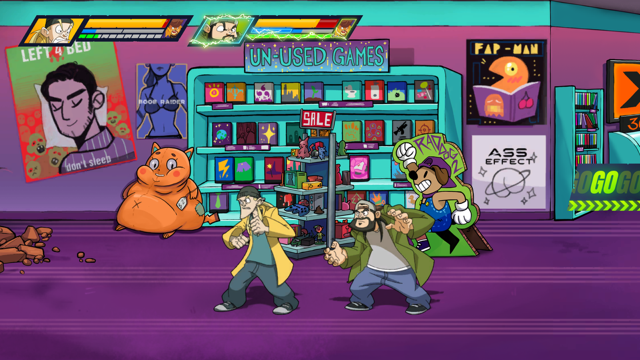
Stats and Progress Tracking in Jay and Silent Bob: Chronic Blunt Punch
After each stage, the game presents a stat screen tracking enemies defeated, max combo, revives, completion time, and collectibles like “nugs” (enemy drops of “medical” marijuana). On paper, it’s a solid feedback system. It gives you a clear snapshot of performance and suggests replayability.
In practice, it feels disconnected. Those stats do feed into gameplay in some ways. Collecting “nugs” contributes to building your super meter and enables assists, which can make a noticeable difference during runs.
The problem is how that connection is presented. The game doesn’t clearly communicate how those systems tie together, so the feedback loop feels weaker than it should. Instead of reinforcing progression, it often feels like information without a clear purpose. It’s another example of a system that exists without a clear purpose.
Technical Issues and Visual Inconsistencies in Jay and Silent Bob: Chronic Blunt Punch
Beyond its structural issues, the game also struggles with noticeable jank.
There are moments where progression breaks. During one late-game congregation-room encounter, the final enemy failed to properly trigger, leaving the level stuck in an unwinnable state with no way to progress. In another case, invisible progression triggers appeared to fail, forcing full level restarts because enemies or scripted events would no longer activate correctly. In some encounters, an invisible progression trigger appears to time out, leaving you stuck with no clear direction forward. The only solution is to restart the level, which compounds the frustration created by the checkpoint system.
Visual issues show up as well. Transitions between scenes can also feel rough or incomplete. During one late-game mall sequence, entering a hidden underground area abruptly cuts directly into the next room without any proper transition animation, making the sequence feel unfinished rather than intentional. Main characters can become unintentionally transparent when moving through environmental elements like bushes, which feels less like a design choice and more like a graphical glitch.
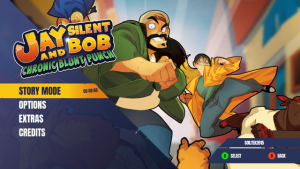
The art direction adds another layer of inconsistency. That inconsistency becomes noticeable when comparing the stylized anime-inspired portraits and menu art against the in-game character models and environments, which often lean much more heavily into retro pixel-art presentation. Individually, both styles work. Together, they sometimes feel disconnected from one another rather than cohesive. At times, the game leans into a stylized look with light anime-inspired touches that give it personality. But that style doesn’t always carry through. Character and in-game visuals don’t always match the art on menus or map screens, which creates a disconnect in how the game presents itself.
None of these issues completely breaks the experience on its own, but together they reinforce the same pattern seen across the game. There are strong ideas here, but the execution lacks cohesion and polish.
Co-Op Limitations
Co-op is present, but limited. Jay and Silent Bob: Chronic Blunt Punch does not support online play, which significantly reduces its appeal. You’re restricted to local sessions, which limits accessibility.
For a game built around replaying levels, co-op should be a strength. Instead, it feels constrained. That limitation cuts into replay value and removes what could have been the most enjoyable way to play.
Final Verdict
Jay and Silent Bob: Chronic Blunt Punch comes down to missed potential. The game shows flashes of what it could be, but never sustains it.
The combat can feel satisfying, especially once you build momentum and access its full set of tools. The concept fits perfectly for short sessions.
But the structure works against all of it. Poor checkpointing, unclear systems, and repetitive progression turn what should be a quick, fun experience into something frustrating. That consistency across platforms makes the issues stand out even more. Its co-op limitations, inconsistent combat, and visual issues all point to the same problem: the game never fully supports its best ideas.
When everything lines up, it briefly becomes what it should have been all along. There is a better version of this game. This just is not it.
Jay & Silent Bob: Chronic Blunt Punch Review
Pros
Combat with great concepts and potential.
Retro-inspired visuals show care and personality.
Locations and references deliver nostalgic charm.
Post-Level stats provide clear performance feedback.
Cons
No difficulty settings.
Levels and bosses can last too long.
Humor and dialogue don't always land and cannot be skipped.
Online co-op support.
Technical issues can hinder progression.
This review was written using a copy provided by the publisher.
