

Magic: The Gathering is returning to its own Multiverse with Reality Fracture, and after looking through everything the set has to offer, several cards immediately stand out. With Prerelease weekend here and the full tabletop release right around the corner, now feels like the perfect time to look at my Top 5 Reality Fracture best cards.
This list is in no particular order, and with the set only just reaching players’ hands, there is still plenty we do not know about how these cards will ultimately perform across different formats.
Before getting into the Top 5, though, we need to talk about a few cards I am not completely sold on. Just like with my previous list, Reality Fracture has several cards that look incredibly powerful at first glance but could end up being traps once players actually start putting them into decks. So, before we get to the Top 5 Reality Fracture best cards, let’s start with some cards I think players may be overvaluing heading into release.

Reality Fracture Trap Cards
Calling something a “trap” does not necessarily mean I think the card is bad. Some of these cards could find the perfect deck or end up performing extremely well in certain situations. Instead, these are cards where I think the initial hype could outweigh what they ultimately accomplish once people start playing with them.
Entrust the Spark
Entrust the Spark immediately reminds me of a Tinker-style effect for planeswalkers.
For five mana, you can sacrifice a planeswalker, search your library for another planeswalker, and put it directly onto the battlefield. That sounds incredibly powerful, especially when Empower Jace can potentially give you planeswalkers to sacrifice.
The problem is that putting a planeswalker directly onto the battlefield is not always the same as casting it. Take Ugin as an example. One of the things that makes the current Ugin so powerful is its cast trigger. If you use Entrust the Spark to put Ugin directly onto the battlefield, you bypass that trigger entirely.
There will undoubtedly be planeswalkers where Entrust the Spark is worth playing, and cheating something expensive onto the battlefield will always get my attention. However, I think the comparison to cards like Tinker could make this look more broken than it actually is.
Tarmogoyf
There was a time when seeing Tarmogoyf across the table was terrifying. Magic has changed. Tarmogoyf itself has not suddenly become a bad card. It is still a two-mana creature capable of becoming very large for its cost, and the addition of newer card types over the years has technically given it even more ways to grow.
The problem is power creep.
Creatures have become substantially more powerful over the years. Modern Magic regularly asks creatures to provide immediate value, generate cards, disrupt the opponent, or accomplish something beyond simply having impressive power and toughness. Tarmogoyf used to be one of the standards by which efficient creatures were judged. Now, I think some players may be valuing the name Tarmogoyf more than the card’s actual place in today’s game.
Maybe Reality Fracture gives Goyf another opportunity to prove me wrong. I am certainly interested to see what happens. I am just not ready to assume that the monster that terrorized Magic years ago will automatically do it again.
Emrakul, the Exigent Doom
It is an Emrakul, so naturally everyone is going to look at it. Emrakul, the Exigent Doom is a massive Eldrazi with flying, trample, and a brutal ward cost that requires an opponent to sacrifice three permanents. Casting it also untaps all of your lands, and Emrakul can help set up its own arrival by being exiled from your hand to give one of your lands the ability to produce additional colorless mana.
A lot is happening here. My concern is that there is also a giant 10 sitting in the mana cost. The ability to turn one of your lands into additional acceleration certainly helps, and untapping all of your lands when Emrakul is cast can create some absurd turns. However, you still need to actually reach the point where you can cast it. And going down a card to make your land tap for 2 isn’t that great, with a payoff being one of the least powerful Emrakuls made.
I would never completely dismiss an enormous flying and trampling Eldrazi with this much upside. I just think the name Emrakul and the sheer amount of power attached to the card could cause players to underestimate how much work is required to actually get it onto the battlefield.
Omnipresence
Omnipresence might have one of the scariest-looking effects in the entire set. It allows you to cast spells from your hand without paying their mana costs as long as their mana value is less than or equal to the number of creatures you control.
That can obviously get ridiculous. It also costs eight mana. More importantly, you need enough creatures already on the battlefield to take advantage of the effect. That means Omnipresence asks you to establish a board, resolve an eight-mana enchantment, and still have worthwhile cards left in your hand to cast afterward.
If everything goes according to plan, the ceiling is enormous. I am just not convinced everything will go according to plan often enough. If you are cheating it into play, then just play Omniscience.
Commander players will undoubtedly find ways to do ridiculous things with Omnipresence, but this is exactly the type of massive effect that can look unbeatable during preview season before the realities of actually casting it enter the equation.
Samut, Tyrant of Naktamun
This may be my most controversial trap pick. Samut, Tyrant of Naktamun gives your instant and sorcery spells split second. That sounds terrifying because split second prevents players from casting spells or activating non-mana abilities while a spell with it remains on the stack.
However, split second does not mean nothing can happen.
Triggered abilities can still trigger, and I think that distinction is going to matter more than some players expect. Players sometimes look at split second and treat it like a blanket statement that an opponent cannot interact at all, which is not quite how the mechanic works.
There is also Samut herself. Once she is sitting on the battlefield, she can still be removed like plenty of other creatures. Do not misunderstand me: giving your instants and sorceries split-second can be extremely powerful, and there will absolutely be situations where Samut is fantastic. I think players may overvalue exactly how much protection the ability provides.
Samut could be very good. I am just not convinced she will be quite as unstoppable as she looks on paper.
Top 5 Reality Fracture Best Cards
With the potential traps out of the way, let’s get to the main event. These are my Top 5 Reality Fracture best cards, presented in no particular order. Some have obvious competitive potential, while others stand out because of the interactions and deck-building possibilities they create.
Flickering Hound
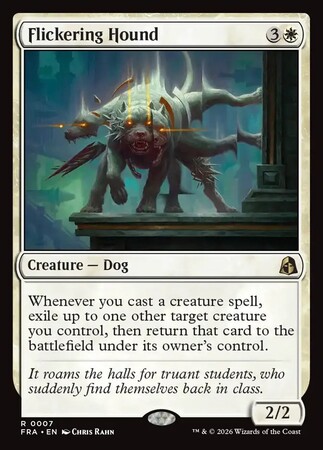
Flickering Hound is exactly the type of card that makes me want to start digging through boxes looking for things to play alongside it. Whenever you cast a creature spell, Flickering Hound lets you exile another creature you control and immediately return it to the battlefield. Essentially, every creature spell you cast becomes an opportunity to reuse an enter-the-battlefield ability.
There are countless creatures throughout Magic that become substantially better when you can repeatedly trigger their abilities. Card draw, removal, life gain, token creation, and plenty of other effects can potentially be reused simply by continuing to cast creatures. The further back you look through Magic’s card pool, the more possibilities start opening up. I am sure players will discover interactions that I have not even considered yet.
Flickering Hound represents one of my favorite things about Magic. I can look at one new card and immediately start asking what older cards I can combine with it to do something ridiculous.
Lich’s Relic
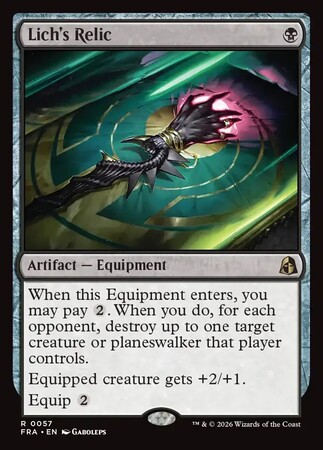
Lich’s Relic is another card where I immediately started thinking about ways to generate additional value. For one black mana, Lich’s Relic is an Equipment that lets you pay two mana when it enters the battlefield. If you do, you can destroy up to one creature or planeswalker controlled by each opponent. Afterward, it sticks around as an Equipment that gives the equipped creature +2/+1.
In a normal one-on-one game, that gives you a removal spell that leaves something useful behind. In Commander, things get considerably more interesting.
Because Lich’s Relic can potentially destroy something belonging to each opponent, the card scales nicely into multiplayer games. Instead of trading one-for-one, you could remove several threats and still have an Equipment remaining on the battlefield afterward.
It also has an enter-the-battlefield ability, which immediately makes me wonder about ways to reuse it. There are many “blink” effects that exist in multiple formats, which could prove quite useful in abusing this, especially in Commander. That is the type of card I am always interested in experimenting with.
Darklight Phoenix
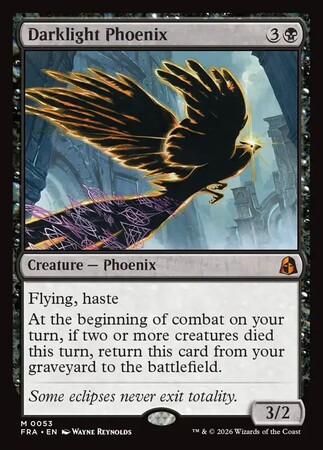
Darklight Phoenix is one of the cards from Reality Fracture that I could see players experimenting with across multiple formats. For four mana, you get a 3/2 Phoenix with flying and haste. That is already a reasonable start, but we are playing a Phoenix, so naturally the interesting part is figuring out how to bring it back.
At the beginning of combat on your turn, Darklight Phoenix can return from your graveyard if two or more creatures died that turn. The important part is that the ability does not say your creatures. Your opponent’s creatures count too. That opens up a lot of possibilities. Removal spells can help turn the Phoenix on, sacrifice strategies can enable it, and trades involving creatures from either side of the battlefield can contribute toward bringing it back.
You do not necessarily have to build your entire deck around sacrificing your own board just to make Darklight Phoenix work. Recurring threats have historically been something players need to respect, and I think Darklight Phoenix has enough flexibility that players are going to experiment with it in several different formats. I know I will.
Karn, Argent Defender
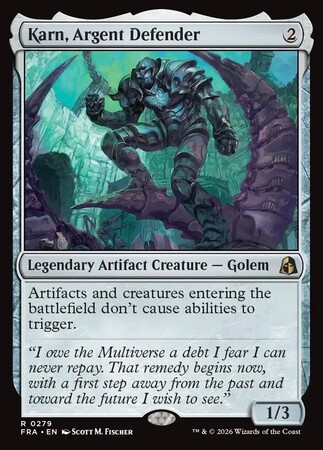
Sometimes a card does not need an entire paragraph of abilities to get my attention. Karn, Argent Defender can prevent artifacts and creatures entering the battlefield from causing abilities to trigger. That can shut off a huge number of cards and strategies. And if you know me, I am the “that guy” that likes to prevent my opponents from playing the game.
Enter-the-battlefield abilities have become such a massive part of Magic that being able to simply tell those cards “no” can be incredibly disruptive. Karn also goes beyond only stopping creature-based triggers by shutting down abilities caused by artifacts entering the battlefield as well.
What I really like is getting that effect attached to a creature. Karn can disrupt what your opponent is trying to accomplish while still giving you a body on the battlefield. Of course, being a creature also means it is vulnerable to creature removal, so there is a tradeoff.
Still, there are going to be plenty of situations where Karn can completely change how an opponent has to play the game, and I am interested to see where it finds a home.
Theorist’s Sanctum
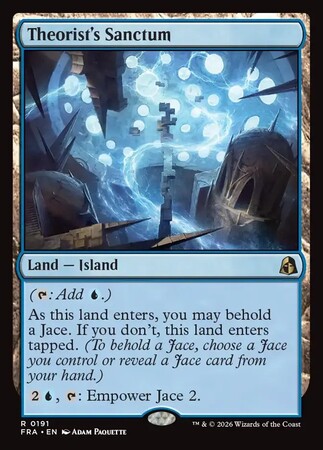
Theorist’s Sanctum may not look nearly as exciting as some of the giant creatures and flashy spells in Reality Fracture, but it is exactly the type of card I could see becoming valuable in the right strategy. The big thing for me is the ability to Empower Jace at instant speed. That flexibility could be especially useful in control decks. Control players already want to leave mana available during an opponent’s turn for counterspells, removal, and other interaction.
If your opponent does not give you something worth spending that mana on, Theorist’s Sanctum gives you another option. Instead of wasting the mana, you can put it toward building your Jace.
That may not sound as exciting as dropping a giant Eldrazi onto the battlefield, but having multiple ways to use your mana is incredibly valuable in a control strategy. I am very interested to see whether Theorist’s Sanctum ends up finding a home in those types of decks.
A Fun Reality Fracture Combo
Before talking about my overall feelings on Reality Fracture, there is already one combo involving the set that I have to mention. Remember Kasmina, Enigma Sage from Strixhaven: School of Mages? You would be forgiven if you didn’t. Kasmina has seen very little play over the years, but her static ability gives each other planeswalker you control access to Kasmina’s loyalty abilities. For a long time, that was not enough to make players particularly interested in building around her.
Reality Fracture may have changed that. Jace’s Machinations allows you to activate loyalty abilities of Jace planeswalkers at instant speed for the turn. More importantly, it empowers Jace to 8.
If Kasmina is already on the battlefield, Jace’s Machinations can give you a Jace token with eight loyalty. Because Kasmina shares her loyalty abilities with your other planeswalkers, that Jace can immediately access Kasmina’s -8 ultimate. Kasmina’s ultimate lets you search your library for an instant or sorcery that shares a color with her and cast it without paying its mana cost.
So what should we find?
How About We Enter the Infinite
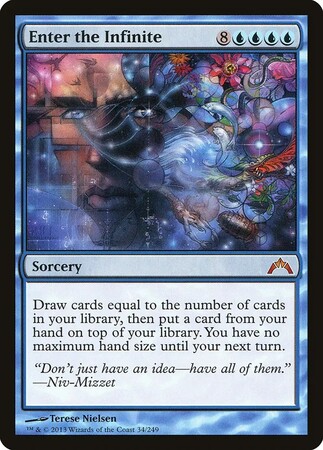
How about Enter the Infinite? Casting Enter the Infinite allows you to draw your entire library, essentially. From there, free mana sources such as Mox Amber or Lotus Petal can give you the mana needed to cast Thassa’s Oracle and potentially win the game on the spot.
The craziest part is that Jace’s Machinations allows the loyalty ability to be activated at instant speed. That means you can potentially start the process during an opponent’s end step instead of exposing the combo during your own main phase. Whether this ends up becoming a major competitive strategy remains to be seen, but I love interactions like this.
A new set releases, players start digging through years of old Magic cards, and suddenly Kasmina, Enigma Sage has a completely new reason to exist. That is one of the best parts of deck building in Magic: The Gathering.
But Is Reality Fracture Actually a Good Set?
While talking about Reality Fracture, my buddy Michael from Canada asked me a pretty straightforward question:
“But is Reality Fracture even a good set?”
From everything I have seen so far, I think it looks like one.
One of the biggest reasons is simply how refreshing it feels to be back in Magic’s own Multiverse. We have gotten plenty of Universes Beyond releases featuring outside franchises, and those sets certainly have their audience. Still, there is something nice about getting a major in-universe set centered around Magic’s own characters, history, and Multiverse again.
It just feels like Magic: The Gathering. The story has also been one of the things that has grabbed my attention. Jace is at the center of everything, and his attempt to create the Echoverse allows Wizards of the Coast to play around with familiar characters and pieces of Magic’s history in some interesting ways.
Seeing what Jace is doing, what he is changing, and the potential consequences of his actions gives the set an identity beyond simply being another collection of cards.
The Gameplay is Great
Then there is the gameplay. Empower Jace is one of the major new mechanics, and there are plenty of other cards throughout the set that immediately make me want to start brewing. Even some of the cards I am skeptical about have interesting designs that I want to see players experiment with.
That is probably one of the biggest compliments I can give a new Magic set. I look through Reality Fracture and want to build decks.
Maybe some of these cards will completely disappoint me once we actually start playing with them. One of my trap picks might become a format staple and make this article look ridiculous six months from now. Maybe some random uncommon I barely noticed will end up being one of the strongest cards in the entire set.
That discovery is part of the fun. Right now, though, Reality Fracture looks like the type of in-universe Magic set I have been wanting to play.
Final Thoughts on Reality Fracture
Reality Fracture has a lot to prove once players actually start putting these cards into decks, but heading into release, I am excited. The story has pulled me in; being back in Magic’s own Multiverse is refreshing, and the set has enough strange mechanics and build-around cards that I already have plenty of deck ideas running through my head.
More than anything, that is what I want from a new Magic: The Gathering set. Give me cards that make me stop and think. Cards that make me dig through my collection. Give me cards that make me want to build something completely ridiculous just to see if it works.
Whether one of these Top 5 Reality Fracture best cards becomes a format staple, Tarmogoyf proves me completely wrong, or someone breaks the game with a card I barely noticed during preview season, finding out is part of the fun. Prerelease weekend is here. Now it is time to start brewing.
