

Part 1: Game Budgets vs. Operational Cost
If you spend any time talking about video games on social media, I’m sure you’ve seen the headlines regarding the cost to develop modern “AAA” (Triple-A) video games. They usually look something like this:
“Video Game Budgets Exceeding $200M”
“XYZ Game Rumored to have Cost $400M”
(Keep in mind these numbers usually lack marketing.)
There’s absolutely no debate that the cost to develop an individual video game has increased significantly over the past 30 years. It’s not just inflation. There are multiple factors at work here: cost of living, compensation, benefits, team size, time on project, etc. The video game rumor factory loves to spread unverified budget numbers, but there is some truth to it: Games at the most expensive level have reached budgets that were once considered absurd.
Unfortunately, there is an even bigger problem lurking under the surface: Operational Cost.
Game Development is Unique
In case you weren’t already aware, game development doesn’t work like a Hollywood movie. When a movie is made, hundreds of people come together to work on the project, but go their separate ways when the project ends. Game development budgets aren’t the same as filming a movie. In most cases, the studio already exists. The studio is already paying people to be there, regardless of what they are doing all day. The project cost of a video game being built “in-house” is the time & labor expense placed into a virtual bucket. The “bucket” represents the resources to build the game (we often call that capitalized labor).
But here’s the thing: That virtual bucket isn’t real. It’s a product of accounting. The money to run the business was spent paying out the salaries & benefits of the people at the studio. Even in cases where an individual game budget requires extended costs like motion capture, most of the expense comes down to the employment of labor.
The more people that work at a studio, the higher the operational cost. The higher the operational cost, the more expensive it is to keep that studio open. The more expensive it is to keep a studio open, the greater the expectations for the games they produce.
The reason I’m bringing this up is that game budgets are often blamed for unrealistic expectations or the collapse of a studio, but from a financial perspective, that isn’t the core problem.
Part 2: The Cost of Doing Business
In the traditional game development scenario (more on this later), a studio is usually held as a subsidiary of the parent company, or an internal business unit. While there are some differences between the two structures, we don’t need to worry about it for this conversation. The point is that the studio is basically its own miniature business inside the parent company. Obviously, that studio needs employees to function. In the case of a studio that has been around for several years, it can often contain anywhere from 50 to 400 employees. The biggest game projects will often involve multiple studios and several thousand personnel, but let’s just stick with the single studio model for today.
As with most businesses, the employees are receiving compensation to be there, regardless of what they are doing. The company is constantly paying out salaries and benefits regardless of what is going on inside the studio. Are they prototyping? Are they working on a new project? Do they have multiple projects going on? It doesn’t matter. There is a base cost to run the studio, regardless of the work assigned to each employee.
If you’re not already aware, a shorthand method exists for determining the approximate cost it takes to run a studio for about a month. Please note, this formula can be used across different businesses. It is not reserved for game development.
Number of employees x $15,000 = Approximate cost to run the business for one month.
For example: 100 person team x $15,000 = $1,500,000 (USD) per month
One year of development: $1,500,000 x 12 months = $18,000,000 per year
As you can see in the formula, there are only two major components. If either of those factors goes up, the cost increases. In fact, the cost of living has become so high in certain urban areas that the $15,000 multiplier is likely out of date (more on this later).
If this is math overload, how about a real example from a studio? At the time of writing this, Arkane (Lyon) was a subsidiary of Zenimax. Zenimax is a subsidiary of Microsoft. Arkane doesn’t collect independent revenue from sales. They are paid by their parent company for development work. Thus, their “revenue” is nearly 100% based on development they charge back to Zenimax. They are the near-perfect example of what it takes to run a 200-person studio in an area with an average cost of living.
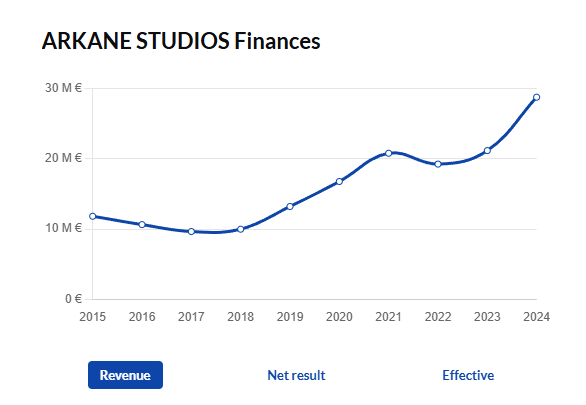
Note: This graph is missing 2025 revenue (over 30 million EUR).
As you can see in the graph above, Arkane was charging Zenimax nearly 30M EUR for yearly operational cost in 2024. However, it went up from there. Their financial report demonstrates that by the end of 2025, the number continued to rise.
When XBOX executives talk about the rising cost of development, this is a prime example. The studio is currently working on Marvel’s Blade, but simply paying their bills is now costing Zenimax (Microsoft) over 30M EUR per year. 30M is three times the cost to run the studio in 2018, and about 50% more than when they released Deathloop. Keep in mind this expense occurs year over year, without even as much as an approximate release date for Blade. (Note: XBOX announced that Arkane is taking steps to review strategic options and potentially exit Microsoft.)
id Please
Since we’re talking about XBOX, let’s take a look at another example: id Software. Unfortunately, the studio saw significant cuts during the XBOX restructure. Given the available information, it appears that approximately half the studio has been laid off. This deep restructuring caused many to speculate that the studio wouldn’t even continue as a stand-alone entity, instead becoming a support studio for other projects at XBOX. The team at id quickly put these rumors to rest by confirming that they are, once again, the size they were when they made DOOM (2016).
Let me be clear: I am not celebrating layoffs at id Software. I played every modern DOOM game, including the newest expansion content for The Dark Ages. However, id Software is emblematic of a broader challenge across the games industry: Coming out of the 2010s, and through the COVID years (2020-2021), many “AAA” studios were given the green light to scale up, expand studio headcount, and make bigger / better versions of their games.
Looking at id from a purely financial standpoint, it is difficult to make the case that doubling studio headcount since DOOM 2016 resulted in returns that justified the increased cost. DOOM Eternal appears to have performed the best out of the three modern DOOM games, but when we consider the impact of COVID shutdowns, it becomes an outlier. (Note: Doom player count is always a mix of Game Pass players and traditional sales.)
Burgeoning studio costs are not a problem reserved for XBOX. Let’s take a look at one of PlayStation’s flagship internal studios, Naughty Dog (herein referred to as ND). In 2023, co-president Evan Wells announced his plan to retire at the end of the year. Congratulations are obviously in order, but his retirement isn’t the focus of this article. Instead, I want to highlight the fact that he revealed ND had grown to over 400 people. Let’s do some math, shall we?
400 x $15,000 x 12 mo = $72,000,000 per year
Using our rough estimation process, it costs about $72M (USD) per year to cover general expenses. They didn’t always employ 400 people, but we can safely assume that it has been that way for several years. Even prior to 2023, the number of people at the studio almost certainly crossed over 300. The point is, ND is an expensive studio to operate. It’s not Rockstar expensive, but let’s be honest: It’s exceedingly expensive for a studio that lacks any live service revenue stream. The cost to run the studio creates immense pressure for their titles to sell in the tens of millions.
Today, the studio is betting on Intergalactic The Heretic Prophet as their next multi-million seller. The title has been in development since 2020, but when it was revealed in 2024, it was clear the game wasn’t anywhere close to coming out. As of writing this (September 2026), we have yet to receive any hint of the release date. Needless to say, a studio of their size is under immense pressure to deliver, regardless of the number of titles they are working on.
The other reason I highlight Naughty Dog is to examine another significant problem in the games industry compounded by operational cost: Time to market.

Naughty Dog now employs over 400 people. Intergalactic is their primary focus at the moment.
Intergalactic has been in development for six years at the time of writing this. It certainly isn’t coming out in 2026. What are the chances it will be released in 2027? 2028? Regardless, we know it’s probably more than a year away. In terms of financials, we can make an educated assumption that the capitalized project cost for Intergalactic won’t be equivalent to the full cost of running the studio, but it almost doesn’t matter. Remember, in the games business, most of the cash expense comes from compensating people to come to work every day. The longer it takes to release Intergalactic, the longer Sony is paying the bills for a business unit that is, effectively, a financial loss factory.
Large studios like ND are especially susceptible to the rising operational cost death spiral. Increased expectations have a tendency to cause large studios to hire more people. Increased cost comes with pressure to sell more copies of a game. Banking on bigger hits often creates scope creep (additional features might help the game sell more copies to more people). Expanded scope extends the timeline, which in turn delays revenue coming back to the company. Delaying revenue places more pressure on the studio to complete the project, which in-turn often results in additional hiring. The cycle continues until something breaks.
If you want further proof of how absurdly expensive it is becoming to develop games, especially in North America, I highly suggest this interview with Tim Willits (Saber Interactive). The short version? Many “AAA” studios in North America have a burn rate of greater than $2M (USD) per month.
Part 3: Reducing Operational Cost Burden
The games industry has been in a general growth trend since the 1980s. What was once considered a hobby for children has grown into a multi-billion dollar industry that caters to many demographics. This is all well and good, but the general model of how the biggest studios operate hasn’t changed all that much since the 1990s. They simply got bigger. Publishers expanded. Studios hired more people. However, there is little doubt that something changed around 2022. Video game industry layoffs started trending upward until they reached a peak in 2024. Layoffs are a reality in any industry (games are not special unicorns), but the numbers we’ve seen the last few years are indicative of a deeper economic issue.
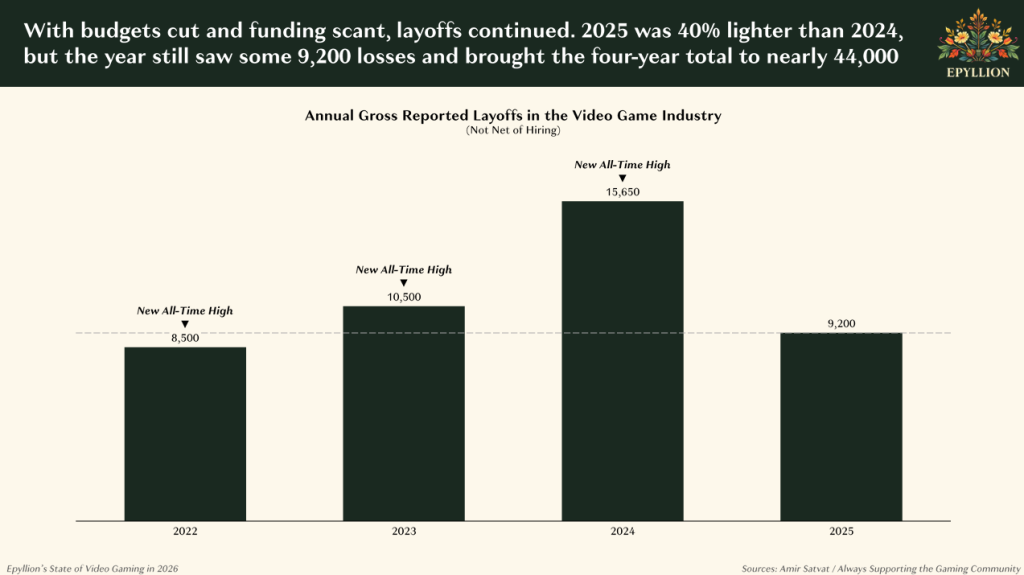
There is a tendency in the video game social media echo chamber to see these kinds of numbers and blame large corporate entities for allowing it to happen. It is true that platform holders and publishers have made serious miscalculations from time to time. COVID over-hiring is a prime example of an industry miscalculation, but the layoff numbers we see today go far beyond corporate incompetence.
For a moment, I want you to consider this next question from a purely functional point of view: When we look at the graph of layoffs above, what is happening on a financial level?
The answer is quite simple: Operational cost is being forced out of the industry across the board. There are multiple reasons (supply saturation is likely a leading cause), but it’s impossible to ignore the data on the aggregate level. Whether we like it or not, the industry is in the midst of a fundamental realignment of demand, supply, and cost. In fact, the games industry of 2026 is a textbook example of an industry suffering from overproduction. Oversupplied markets force production to fall, especially when the returns can no longer justify the cost. When production falls, people are laid off across the industry.
If you made it this far, maybe you’re asking yourself what happens next. The following are three solutions I often see proposed via social media and Reddit:
“Reduce scope and ship more often.”
This is a perfectly fine idea and one that attempts to solve the problem of budgets spinning out of control. In this scenario, you might end up with three $100M games over six years instead of one $300M game over the same time frame. The problem with this “solution” is that it contributes to oversupply, and it fails to tackle operational costs. Don’t get me wrong, I believe that the games industry needs to focus on reducing scope across the board. This concept is good in practice, but doesn’t do anything to tackle the core economic issues.
“Game teams need multiple chances to find their big hit”
This is a non-starter today, but it comes up far more often than it should. To be fair, this concept isn’t without merit, but it is rooted in an era when even “AAA” teams were much smaller than today. If someone says, “Teams become more cohesive over time,” that is generally true. Most large teams become higher-performing over time and develop significant domain knowledge. However, we’re not addressing the underlying problem: operational cost. There is very little financial wiggle room in today’s industry. Most “AAA” studios (today) operate on the financial buffer for one, maybe two failures at most.
“Focus on games with the best chance of commercial success.”
This concept often comes about after years of various projects going sideways or underselling expectations. Suddenly, the financials aren’t looking so good, and the publisher needs a hit. What better way to do that than just doing the thing that made them successful in the first place. To be fair, this is a strategy with a proven track record. It’s obviously not a guarantee of success, but it’s probably one of the better options available. The biggest issue with this strategy is that it often comes into play too late. Publishers (and individual developers) often employ this strategy after multiple failures. By the time they get to realizing this, the financials are already upside down.
Here’s what you need to understand about the proposals above: They remain heavily dependent on demand to make them work, and that’s partially how the games industry got into its current oversupplied mess. Everyone assumed demand would just keep going up.
Operational Cost Must Decrease
There is only one way forward for the games industry (especially in North America): Operational cost must decrease. Refusal to do so will only perpetuate the layoff cycle and place the games industry in an ever-more volatile state.
This is probably where I should state that this next section is primarily my personal recommendation for how the games industry moves to tackle burgeoning operational cost. It’s based on my own experience and education, but it will be the most difficult for the audience to accept. I also want to state that discussion and disagreement should be embraced. A healthy discussion, one where we learn from each other and embrace our differences, is one where we can learn to disagree (respectfully). Regardless, here is my recommendation for how the industry moves forward from the chaos of the past several years, especially in “AAA” development:
- The core staff at the studio needs to shrink in overall headcount. If already impacted by layoffs, the studio must be resistant to over-hiring in the future. The studio should be staffed with generalist positions where possible. For example, generalist artists instead of single-role artists. Over-specialization is one of the leading causes of cost ramp and hiring inconsistency. To be clear, I am speaking to traditional “AAA” style development for single-player and possibly co-op experiences. If a company plans to do any long-term live-service support, or is trying to run something like an MMO, they need to be structured to do that. However, in this model, they become a smaller component of the overall development process, because…
- The core studio team will be supported by significant contract and co-development agreements. If the “AAA” games industry (might as well include “AA” here as well) is going to stabilize, it should lean into the movie production model. Besides oversupply, one of the leading causes of the boom-and-bust layoff cycle is that studios can’t find work for hundreds of people during early phases of game development. The large studios previously fixed this problem by often running two or more games in development, but over the past decade it has become increasingly difficult to run that playbook. The large studios today typically run one (fully committed) project at a time. (The alternative method here is to run a network of flexible, lower-cost studios. Saber Interactive is a prime example where the studios often co-develop with each other.)
- The “AAA” games industry must become more resistant to scope creep and over-development. Ultimately, scope creep, feature creep, and over-development all end up impacting the project with increased cost and longer time to market. This is a massive poison pill to a game’s chance for financial success. As project teams grow, internal conflict arises as everyone on the team works to justify their role. This justification “battle” often directly leads to scope creep, as the producers try to satisfy the desires of the entire team.
- Select A.I. tools should be implemented in the production pipeline. Please understand this does not mean generative A.I. images and A.I. “slop.” Instead, this is the reality that most developers now have access to generative code agents and various A.I. assistants found in modern engines. Implementation of these tools is expected to reduce redundant tasks and increase development efficiency. There is a massive difference between using A.I. to generate unplayable nonsense and using it to get work done.
Controlling Operational Cost to Build Sustainable Games Studios
I am a strong proponent of overhauling many studios in the games industry with the above model because I see it as the most logical way forward. Even if only partially implemented, the operational cost of a large studio should become less of a burden at the corporate level, especially during periods of financial stress. If successful, it should lead to core studio positions becoming consistent, reliable, gainful employment.
We must accept that the studio might only employ 150 people instead of 300, but those 150 people will have a better chance of avoiding the “boom and bust” economics of today. This does not make a studio impervious to layoffs/closure, but it adds a layer of resiliency. (Recommended viewing: Tim Cain discusses the fact that the games industry will always be unstable.) Does every studio need to do this? No, of course not. There are select businesses in the games industry who have managed to control their costs while also effectively producing content. This article is about the bigger picture, not the exceptions.
Over the course of my career, I’ve learned that large, bloated teams / budgets often act against the success of the project. I can tell you with 100% confidence that one of the biggest poison pills in modern game development is the lack of (healthy) friction and / or limitation. Most project professionals (like myself) understand that reasonable constraint will improve project success and team cohesion. Think of constraint as the walls that hold the building (project) together. The walls are immovable, but they are required for the integrity of the building.
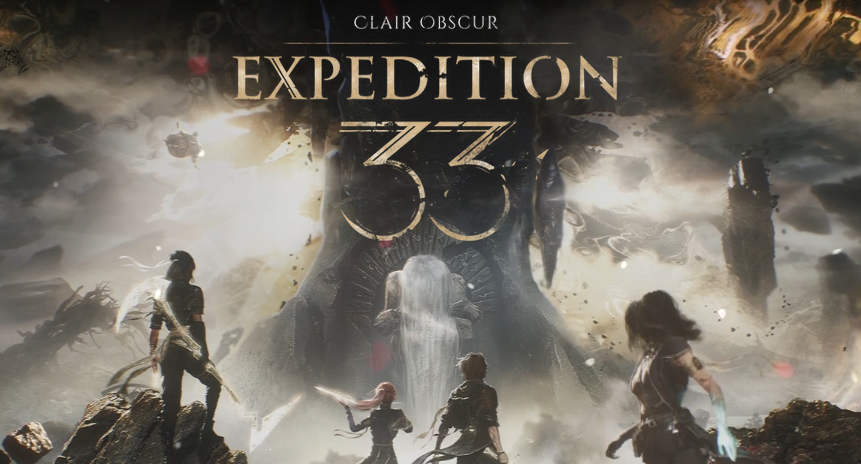
Expedition 33 is a near-perfect example of a small team being extremely efficient with their limited resources.
Clair Obscur Expedition 33: A Standout
One of the most recent examples comes from Clair Obscur Expedition 33. The team understood their limitations and saved costs by implementing enemies that lacked faces. I don’t believe there is a logical argument that the game was any less playable because of that choice. (For the record, Expedition 33 is filled with creative shortcuts. The game is brilliant in so many ways because the development team understood their limitations.) On the corporate side, stricter game budgets and timelines must be set. On the studio side, the team must accept the constraints. Games like GTAVI are the exception. The industry needed to deal with the scope creep problem…yesterday.
The last thing that I’ll say on this topic is that studios running highly unique technology will likely need to keep more people in-house to deal with it. However, that doesn’t mean other components of the game cannot be contracted or co-developed. Like many things in life, it’s a balancing act.
Conclusion
Competition in “AAA” gaming is coming from everywhere. Global development teams are now competing with Western development, often able to produce highly reviewed games at half the cost. TikTok, Roblox, Fortnite, and YouTube have largely absorbed the younger generation (under 21), and it’s unclear if their tastes will expand/change when they age. At the same time, the core demographic is slowly aging up. While this has given them more money to spend, many in that cohort don’t have enough time in the day to play more than a couple “large” games in a year. Attempts to solve this conundrum, such as XBOX Game Pass, have been met with limited success and appear to be soft-capped.
The reality is that the games industry must reduce operational cost and learn to deal with constraints. Failing to accept this reality will only perpetuate the boom-and-bust layoff cycle. It’s time for large publishers and studios to deal with it, instead of the labor market’s economics forcing it on them.
Guest post by RallyCarDelta Gaming
Follow on X
Follow on Bsky
Additional articles by RallyCarDelta Gaming: gameoverthirty.com
